




Friday, February 19, 2010
Stupa-fied in Myanmar
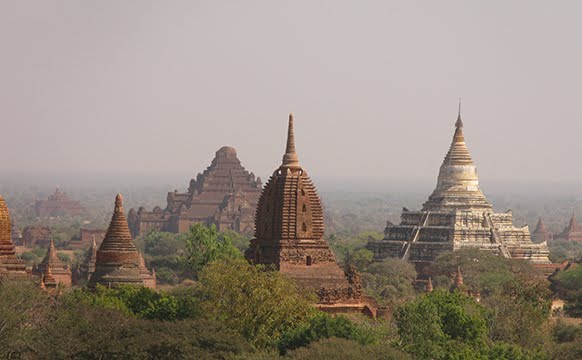
We’ve been in Myanmar almost three weeks. It feels like the place we were looking for on our trip to SE Asia. How could one not like a country with Spirulina Beer?
We got on the plane in Bangkok not knowing quite what to expect upon our arrival in the Yangon, the capital of Myanmar. Myanmar has the reputation of having one of the most authoritarian and oppressive governments in the world, a military regime that came to power in 1962. What would the oppressed people be like, and how would we be treated, we wondered.
A lot of travelers choose not to travel to Myanmar because they are afraid part of the money they spend will go to support the military regime, and that their very presence will somehow legitimize the government’s existence. On the other hand, does staying away somehow help the situation, or does it just allow it to continue in secrecy? We considered those arguments and more, both for and against, and decided we would come. Good decision.
While I’m on politics I’ll briefly address the question of whether to call the country Burma or Myanmar. Short answer: Myanmar. There are plenty of good reasons to call it Myanmar, starting with virtually everybody here does.
“Burma” was the name given to the country by the British during their occupation, because the majority of people are ethnic Bamar, or Burmese. The government changed the name to Myanmar in 1989. The official reason was to distance the country from its colonial past. At the same time a number of other place names were changed from their British-era names.
There is some ethnic tension between the ethnic Burmese majority and the non-Burmese minority—quite a few ethnic and quasi-ethnic groups. There is no reason the minority groups would want their country to be called Burma. In fact, quite a few non-Burmese areas would like to separate entirely, and refer to their area not as “Myanmar” either, but by its ethnic name, such as “Shan State.”
So we touched down in the capital of Yangon (formerly Rangoon, renamed at the same time as the country) with some excitement, and a little apprehension. Airport formalities were a nice surprise, one of the smoothest and quickest entries we’ve had. Not at all Orwellian. No cameras or fingerprint machines, just an overworked official in a booth stamping passports as fast as he could.
Look for signs of oppression, we kept telling ourselves. We weren’t quite sure what to look for. People at the airport were openly friendly and welcoming in a way we have never encountered.
That first impression has persisted throughout our trip. The more we have seen, the harder it has been to think of the Myanmar people as oppressed. Yes, they don’t like their government, and for good reason. The military regime operates the country like its own fiefdom.
People suspect government spies everywhere, and some have tales of random arrests and imprisonment to prove it. (Contrary to what we read and were told, plenty of people have not hesitated to express their views to us. It is, I think, one of the major benefits, to them and to us, of foreign travelers coming to the country—to hear about the situation first-hand.)
So are the people here oppressed? I think the word “oppressed” implies a certain hopeless passivity, and that does not describe the people of Myanmar. They have a sense of vitality and happiness. It has almost become a joke with us how much people sing here, just walking around, working, or other random situations. More than once we’ve been passed by a motorbike loaded down with several passengers—all singing at the top of their voices. “There’s somebody else singing,” we’ll say.
I think the right word might be “repressed.” They are not being held down, they are being held back. It feels like there is a lot of potential here. Eventually the government will change; there is supposed to be an election later this year. Whoever is in charge in the years ahead will have their hands full. A democratically elected government will be just the beginning.
Well, I better get on with the travelogue or I won’t have a place to put pictures.
For most travelers to Myanmar, particularly first-timers like us, there are four main destinations: Yangon, Mandalay, Bagan and Inle Lake. The four places form, roughly, a cross, with Yangon and Mandalay at the southern and northern ends, and Bagan and Inle Lake to the west and east. Getting from one to any of the others takes a pretty long bus or train ride—10 to 15 hours—and often at night. So far there are no tourist shuttles, as in many other countries. (There are package tours that carry customers around the country in big buses, but package tours are a money-maker for the government, so independent travelers avoid them.)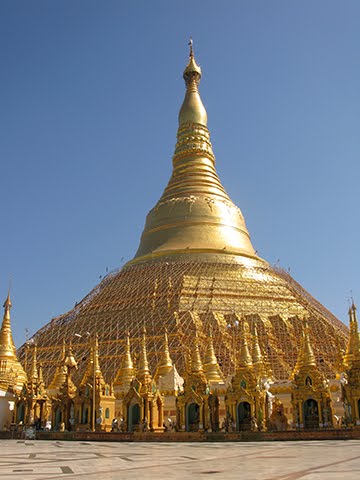
Like nearly everyone, we started in Yangon. Yangon is a big city with a lot of old buildings dating back to the colonial era (which, as Faye noted, look like they could use a good power washing). The streets around these old buildings were throbbing with small markets, food vendors, and people hanging out conducting all kinds of business. There was a stark contrast between the old buildings and the people below them. It was like one civilization living amongst the ruins of an earlier one. 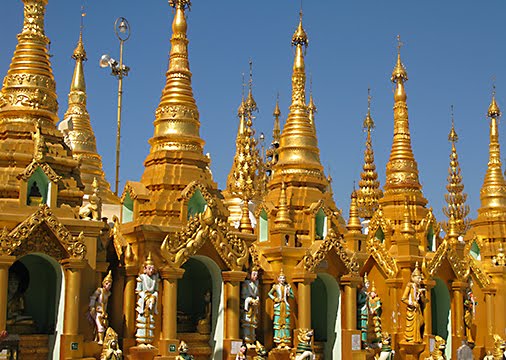
There are two beautiful parks that any city would be proud of, as well as one of the most impressive pagodas we’ve seen (and by now we’ve seen a lot of them.) According to legend, parts of the Shwedagon Paya, or Pagoda, is 2500 years old. At its center is a massive gold stupa, gilded with gold leaf on the lower part, then further up covered with gold plate, up to a crowning ornament of solid gold and silver, with thousands of diamonds and jewels. It is topped with a 76-carat diamond. It is pretty impressive even if you’ve already seen enough pagodas and stupas to last a lifetime.
But we weren’t done with pagodas. Our next destination was Bagan, which is all about pagodas.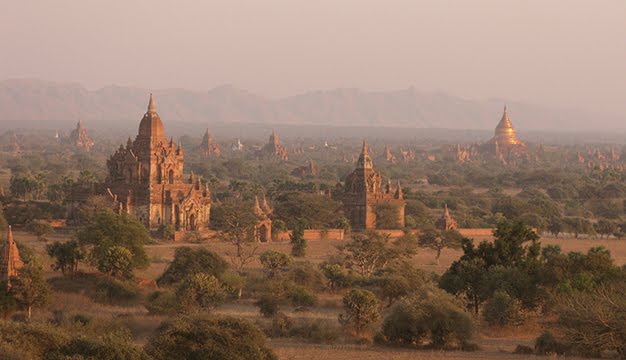 Bagan is a place that makes Yangon seem like a modern metropolis. More than 3000 pagodas and stupas are scattered over a large plain, some dating back more than 1000 years. In 1990 the government relocated people who lived in what is now known as Old Bagan, the area with the highest concentration of pagodas, a few kilometers south to what is now called New Bagan. The result is that Old Bagan, while not completely devoid of life, has a timeless feel to it. At sunset we (and every other tourist in Bagan) climbed to the top of one pagoda and watched as the sun bathed the ancient temples in a warm glow. It looked like the setting for an Indiana Jones movie. We spent a couple days exploring the area, by horse cart and bicycle, then caught a bus to Mandalay.
The road to Mandalay, it turns out, is bumpy and broken. We rode an old, rattling bus through a parched landscape. By the time we arrived we felt old and rattled as well.
Mandalay feels older than it actually is, just 150 years or so. For most travelers it serves more as a base to explore surrounding areas than a destination. It has all the hustle and bustle and grime of Yangon, but not much charm. The major attractions are a handful of old sites near the city with—you guessed it—pagodas.
Just south of town one pagoda has a quirky twist—a couple of large pythons have taken up residence around one of the Buddha figures. They have been there for years. Every day attendants lovingly wash and feed them. It is an idyllic existence for the snakes, except for all the people wanting to get their picture taken with them. The attendants gladly oblige, and make a little money doing it.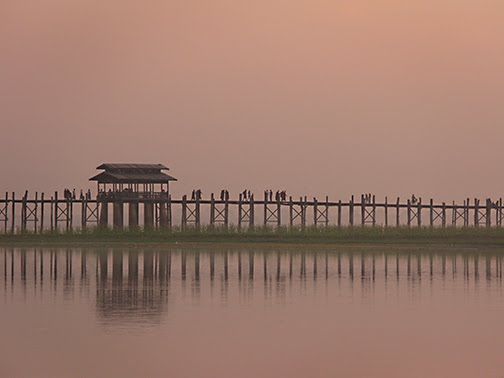 Another site is known more for its picturesque 1.8 kilometer teak footbridge over part of a lake than its pagodas. Tourists, local people and monks flock there at sunset for a stroll across the bridge. Quite a few monks study English, and many on the bridge take the opportunity to chat with English-speaking visitors.
We hired a car and guide to take us around. We don’t normally do that kind of thing, preferring to explore on our own. But we have found that here in Myanmar, a guide has been an invaluable source of information, and we’ve seen things we wouldn’t have otherwise. Our guide took us first to a workshop that made gold leaf, all by hand. The gold leaf is sold to devotees and applied to a well-known Buddha figure nearby, which has become thickly encrusted with gold.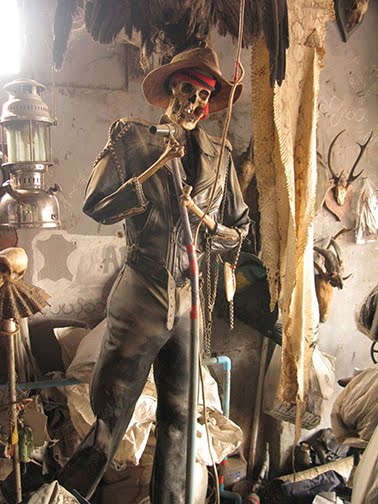 A cluttered leather shop across the street caught my eye and I wondered over and found one of the strangest things I’ve seen—a skeleton, dressed in leather and a cowboy hat, with a microphone clutched in his boney hands. Around him were giant python skins, mounted skulls of unidentifiable animals, and random junk. I don’t know who he was. One friend suggested he might have been a former activist.
We continued north of Mandalay, up into the mountains of northern Shan state, to the town of Kyaukme (pronounced “chow-MAY”), The Shan are ethnic Chinese and make up the majority of that area, but there are other tribal groups as well. With another local guide, and a couple other travelers, we went on a two-day trek up into the mountains, passing through several villages, and staying overnight in a Shan village. We slept in the house of the local headman on the wooden floor in a communal sleeping room.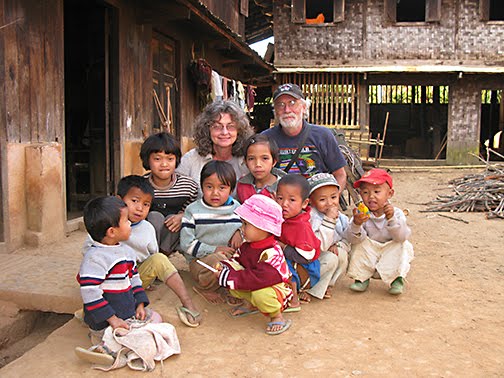
Our guide could speak the local languages, as well as English, and was familiar with the villages and the people in them. He helped with the language barrier, and we felt truly welcome. Unfortunately, sleeping on the floor felt truly uncomfortable. But the night passed and all was well. Our two fellow travelers were great company, and we all had a good time.
We returned to town on Valentine’s Day, which also happened to be Chinese New Year. The guesthouse where we were staying, the only place in the town licensed to deal with foreigners, was party central. For two nights there was a live band, dancers, and dozens of drunken locals enjoying the show. After our trek, and the sketchy night’s sleep, we weren’t thrilled with having a party going on outside our door—the rear of the stage was literally a few feet from our room. But the key to coping with that kind of thing is to join in. We lasted as long as we could, then went to bed in spite of it all.
We returned to Mandalay for a night, then caught a bus for the fourth of the big four destinations—Inle Lake, where we are now. If Myanmar has a tourist destination, Inle Lake is it. We’ve seen more package tourists here than anyplace we’ve been. That said, it still doesn’t feel touristy compared to other countries.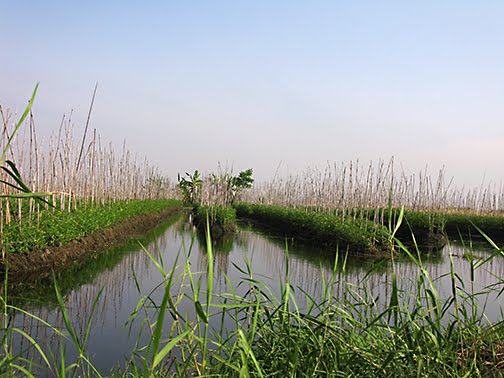 Like nearly everyone who comes here, we hired one of the motorized longboats to take us around the lake to visit various villages, markets and workshops where everything from silk cloth to cheroots to teak boats are all made by hand. What we found most interesting, however, were the floating gardens.
The lake is quite shallow, particularly near the shore. Vast areas have been converted to agriculture by forming rows of the floating lake plants and anchoring them to the lake bottom with bamboo poles. A layer of mud from the bottom is spread on top of the floating rows and then planted with all kinds of vegetables, and even flowers. Lakeweed is harvested and used as mulch on the growing plants. It doesn’t get much more organic than that.
We have about another week in Myanmar. We think our next destination will be a beach. Wherever we decide to go, it will begin with an 18 hour bus ride to Yangon. The closest beach is 5 or 6 hours further. It’s going to be a long day.

Monday, February 01, 2010
Southern Laos
Most of the past week we have spent in a state of pleasant lethargy (which only partly explains the gap since my last posting).
We made it as far south as we could go in Laos, to an island in the Mekong River. The island, Don Khon, is one of a group called the 4000 Islands. The name may be accurate, at least in the dry season when the river is low. But only a handful of the islands are big enough to be inhabited, and most disappear during the rainy season when the river rises 10-15 feet.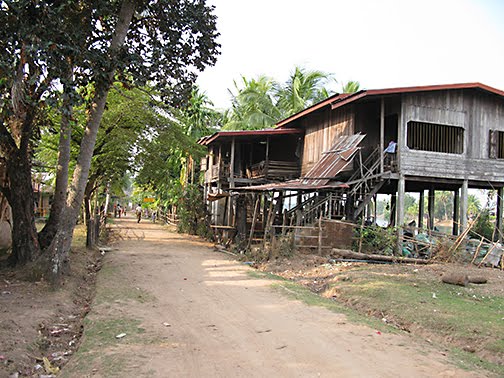 There are three islands with accommodations for travelers. The two smaller, including the one we were on, got electricity just three months ago. The electricity is still of questionable quality, which is the other reason I have not updated for so long. Whenever I plugged in my laptop to recharge, everything got nearly hot enough to melt.
By the time we got to the island we were ready for a break. We had just spent five days in the Lao capital of Vientiane, which was about four more than we wanted to. But we had to wait for visas to our next destination, the country formerly known as Burma.
Vientiane is nothing to write home about— certainly not the seedy but fascinating French Indochinese city that has figured in numerous novels. Well, it still is kinda seedy. But we were offered opium only twice. Perhaps it has gotten tamer at the expense of being interesting.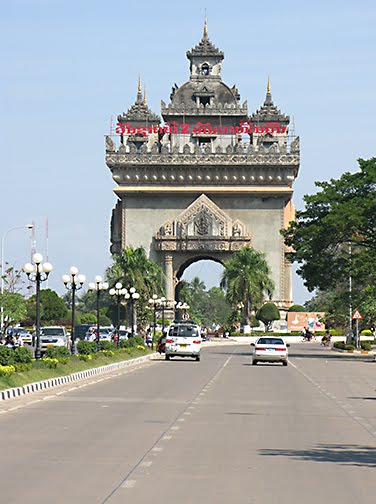 There is a giant avenue resembling the Champs Elysée with the presidential palace (empty, as far as we could tell) at one end and at the other something that, from a distance, looks like the Arc de Triomphe. Though, as a sign inside the structure honestly notes “From a closer distance it looks even less impressive, like a monster of concrete.”
That may seem like a refreshing example of Communist self-criticism, but it’s not. The monument was built in the mid-60s, a decade before the Communists gained control of the country. The concrete used to build it was donated by the US, and meant for the construction of a new airport. Our guidebook notes that local expats refer to the monument as “the vertical runway.”
The Mekong River runs along one edge of the city. When we were there the riverfront, was being terra-formed along several kilometers to make a park with a walking/biking path. The project is being funded by Japan. Giant digging, dredging and bulldozing equipment were busy moving sand and changing the course of the river.
One evening, as we stood looking over the activity, a Japanese man, evidently in charge of the project, arrived with some subordinates. After ordering them around for a few minutes, he saw us and came over to us to explain in enthusiastic, but nearly unintelligible “Japanenglish” what was going on. We got the impression that it was going to be a very nice park, even though we were still fuzzy on the details.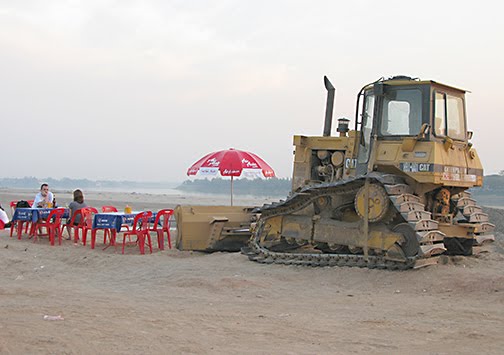 The riverside is a popular outdoor dining spot during the evenings. The presence and activity of the heavy equipment affects the ambience, but that didn’t stop people from eating, drinking and watching the sunset over the Mekong.
When we were finally able to leave town we booked an overnight sleeper bus to our next destination, a southern hub called Pakse. Our bus, like a lot of the large, long-distance buses in Laos, was painted all over with bright, airbrushed graphics. Colored lights illuminated the vast engine compartment. It looked like a rolling bordello.
Inside, it was filled with bunk beds, like a long, narrow summer camp cabin. (So, I guess it might make a pretty good rolling bordello. But there’s not much privacy. It would probably make a pretty good mobile opium den. Not that I’m making any suggestions. I’m just saying…)
Before we left the station there were indications of mechanical trouble; there were ominous knockings from the rear, and the driver seemed to be having trouble with the lower gears. “This doesn’t look good,” I told Faye. But the driver limped the big beast out of town. As long as we were traveling at highway speeds in the higher gears everything seemed to be OK. But every time we had to slow down there was trouble.
Finally, in the middle of the night, in the middle of nowhere, there was a grind and a jolt and some heavy knocking sounds, and the bus died. With all the grinding gears it had been hard to sleep, so we weren’t entirely unhappy that we would finally get some peace and quiet. Most of us dozed for a couple hours before another bus finally came to pick us up—not a sleeper. Considering it was the middle of the night, we were several hours behind schedule, and we had gotten little sleep, the passengers seemed to be in pretty good spirits. I think everyone who travels in these countries half expects something like that to happen sooner or later.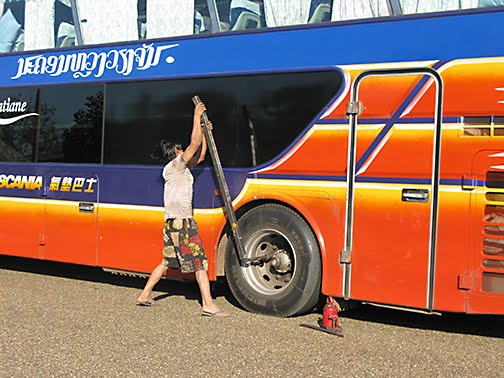 About an hour from our destination, shortly after sunrise, somebody smelled smoke in our replacement bus and ran up to the to alert him. I think we all felt the bus operators needed all the help they could get. But the driver didn’t stop to see what the problem was. A few minutes later a tire blew out.
When our luggage was transferred from the other bus it had hurriedly been piled over a compartment where a spare tire was stored. So all of us piled off the bus as our luggage was being thrown out onto the ground, and tried to make the best of it. A humble Buddhist temple was on one side of the road and a little village was on the other. Some people dozed on the ground, while others wandered around and took pictures of the temple and cute village children, while our bus operators struggled to change the tire with hand tools.
Eventually, all of the luggage was thrown back into the bus, we all got back on and, with our fingers crossed, finally made it to our destination. For the next week whenever those of us who had been on that bus ran into each other, we felt a bond of kinship. We ate and drank together, and recounted horror stories and travel tales. (We were one-upped by a couple who came in later and had been on a small, overloaded vehicle a few days before that tipped over and skidded down the road on its side.)
We spent one night in Pakse and one night a little further south before arriving on the island of Don Khon. We had every intention of spending just a few days, then trying to squeeze in a little more sight seeing before we had to leave Laos. But that was before we started laying in hammocks and watching the Mekong River flow by. Soon we decided there was nowhere else we would rather be, so why go someplace else.
Life in general on the islands seems to flow at about the same stately pace as the river, though with the arrival of electricity that may be changing. There are numerous little family run restaurants and oddly, the food is really good at all of them. We wondered where all these people learned to cook like they do, especially considering that most of the kitchens consist of little besides a rice cooker, a few pots and a couple of woks.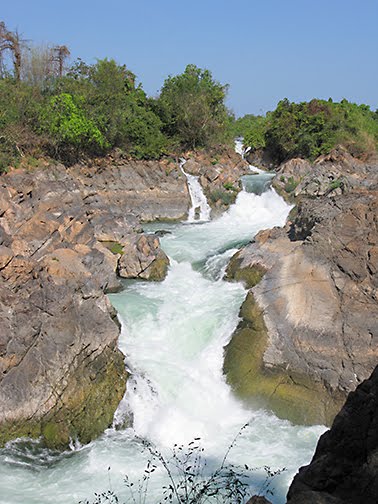 As far as sight-seeing in the area goes there are some spectacular waterfalls, where the usually placid Mekong becomes a seething cataract as it flows around some rocky islands. And guys with boats offer rides in the waters around the islands, especially to the south where one can sometimes see rare Irrawaddy Dolphins. We managed to see a few, but from a distance as they swam in Cambodian waters.
A lot of entrepreneurs have bicycles for rent, which is a good way to get around, even though there is no pavement. There are some dusty roads, a few trails through the woods, and the rocky remains of an old rail bed built by the French.
Nearly all of our time in Laos has been spent along the Mekong River. We’ve seen it flow past cities, and villages and vast tracts of wilderness. It no longer seems exotic, as I felt it was when we first encountered it in the northern part of the country. Instead, it seems almost like a comfortable companion. We’ve seen it only in the dry season, when its waters are low and it meanders along like it has nowhere to go and months to get there. In the rainy season it will come alive again, as will all the rice paddies around it and throughout the country. We’d like to see it then. Too bad I don’t like rain.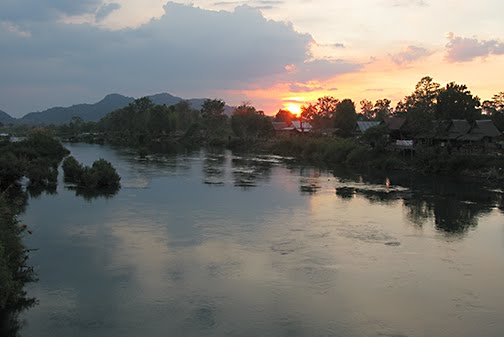 There is much more to Laos than just along the Mekong, of course. I’m sure we’ll be back to explore other areas. We’ve just scratched the surface, but the drift downstream has been a good introduction.
Our next destination is Myanmar/Burma. (What’s in a name? I’ll try to explain it later.) I don’t know what the internet situation is there, so there may be another gap before the next post. Who knows? Much mystery lies ahead.
contents copyright ©2005-2009 Jim McCluskey