




Monday, February 26, 2007
Nicaraguan Backroads
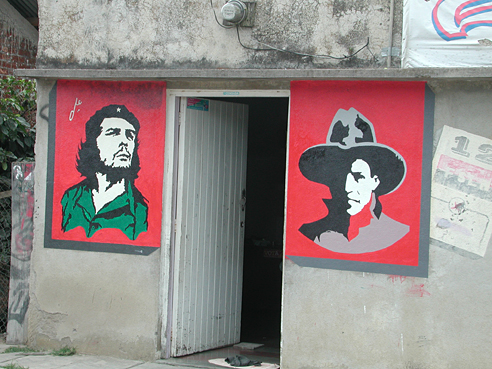
Nicaragua is a country of conflicts and contrasts. Skirmishes and wars going back more than a century, corruption and occasional natural disasters--two devastating earthquakes, in 1931 and 1972, and Hurricaine Mitch in 1992--have made Nicaragua the second poorest country in the Western Hemisphere, after Haiti.
The shadow of the Sandinista revolution in the late 70s and the Contra war that followed still hang over the country, especially with the recent reelection of Sandinista leader Daniel Ortega (just "Daniel" to his supporters). During Ortega's first term, after the revolution, he proved to be as corruptible as those he fought against. His reelection may indicate the Nicaraguan's willingness to give him a second chance or, more likely, how bad the other options were in the three-way presidential race.
At a restaurant I fell into a conversation with an economics professor who described himself as a Sandinista and a revolutionary--but he didn't vote for Daniel. As far as he was concerned the "Danielistas" have betrayed the Sandinista revolution. Daniel has a chance to redeem himself, but it won't be easy.
From where we are right now, as I write, those conflicts seem remote. We have come to a hot springs, developed Nicaraguan style with thatch-covered patios (with hammocks!)and concrete block bungalows. It feels good to soak away some aches from bus rides and bad beds. The cost for our room and food here is way beyond our budget, but we take comfort in knowing that we are contributing to Nicaragua's economic recovery.
Faye arrived in Nicaragua just before Valentine's Day, and we went directly to Granada. Aside from some beach areas on Nicaragua's Pacific Coast with little more than basic amenities, Granada is virtually the country's only tourist magnet. I've written about Granada before. It has an interesting history, but I won't go into it again.
We were charmed by Granada the first time we were there in 2003, and to a lesser degree again the next year. This year I think we decided we've had enough of it. Maybe it was just the heat that wilted our enthusiasm, or too many tourists. At any rate, after a few days of relative comfort we decided to head up into the cooler mountains to the north, off the beaten path.
Our first stop was the town of Estelí. The valley area around town is mostly agricultural. Fresh cheese and yoghurt from local dairies are widely available. Cigars rivaling Cuban's, so they claim, are made in Estelí from local tobacco fields. Coffee bushes grow in the mountains nearby, though someone needs to teach these people how to make a decent cup of coffee.
A couple of nights and a day in Estelí was more than enough, but I spent an extra day exploring the town while Faye recovered from some food-related intestinal distress. One interesting, but potentially hazardous, thing about getting away from tourist areas is that we are forced to eat like the locals in restaurants not only unaccustomed to our fickle foreign taste buds, but perhaps also our standards of hygiene. We take our chances (and occasionally our Pepto-Bismol) and everything usually works out fine, but not always.
The good part is that we eat some food we might not otherwise and are sometimes pleasantly surprised. In Estelí I particularly liked tortillas wrapped around local cheese with cream and cabbage. My other discovery was some delicious peanut brittle. I'm hoping we run across that again someplace.
Getting away from tourists is pretty easy to do in Nicaragua, but getting away from crowds is more difficult. We had read about the Miraflor nature reserve in the mountains beyound Estelí and headed up that direction next. The bus out of town left the pavement almost as soon as we started and for the next 50 miles we traveled a dirt road. We were let off at an intersection a mile short of our destination and we walked the remaining distance. As we trudged along I had plenty of time to think about how I could pack lighter next time.
The reserve is a nearly 100-square-mile forest and agricultural area. In 1990 the residents of the several settlements in the area formed a cooperative of sorts, and dedicated their land to sustainable agriculture, and eco-tourism.
We had made reservations at a place we knew little about except its name and approximate location. We were both pretty tired by the time we reached the place, but as we entered a lush garden through a green wooden gate the scent of orange blossoms made me lift my head. Within a few steps were not only orange trees, but banana trees, ginger, papaya, birds-of-paradise and more.
It felt like an Eden, and it was, in more ways than one. There was no running water or electricity (except for a couple hours of lights in the evening from a generator). The accommodations were basic, but comfortable enough. As we were getting settled a beautiful little black and red bird perched close by our room and ate granola out of our hand. In the garden there were several other varieties of birds, from hummingbirds to a large green parrot.
We spent a day walking down dirt roads in the area, past cattle pastures and little settlements. We saw a few vehicles; most people rode horseback. I don't think there was electricity anywhere, except from generators. The area felt like it was in an undeveloped state preserved from decades ago.
We stayed just a couple nights, and decided to move on. As we left one of the red and black birds landed on my shoulder and began pecking my ear. I don't know what St. Francis would have done, but I had to put a stop to it.
Even as we trudged the mile back to where we could catch a bus, we were glad we had come. We felt like we had discovered something. I don't know if the eco-tourism thing will ever catch on, but maybe it better like it is now.
We spent much of the day on an old school bus, bumping along another dirt road, the kind that fills your nose with dust and makes your insides ache. We were taking the back road to Jinotega. It wasn't exactly the road from hell--there are worse. But it was at least the road from heck and we were glad when we finally got back to pavement.
We spent a couple nights in Jinotega, and then one in Matagalpa. Both towns were hot spots during the Contra War, but there is little worth seeing. About the only good thing we could say about them is that there were few, if any, other travelers. But sometimes even the charm of being the only gringos in town isn't enough.
We've had just about enough of the off-the-beaten-path thing for this trip. There are a couple out-of the way places that sound somewhat interesting--the Corn Islands off the Caribbean Coast, and the San Juan River, which divides Nicaragua and Costa Rica. But it takes quite a bit of effort to get there, unless you fly. From what we've heard it doesn't sound worth the effort.
Faye has two weeks left and we will spend at least part of it on a beach somewhere. I'm sure there will be other gringos. I just hope there are enough hammocks to go around.

Monday, February 12, 2007
A Piece of Paradise
The last week or so in Rio Dulce I spent searching for paradise, and I found at least a piece of it.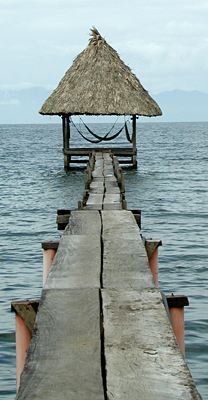 My first destination was an isolated beach on the southern shore of Lake Izabel, about 10 miles from the bridge at Rio Dulce. Twenty-some years ago an ex-pat Canadian named Denny was sailing on the lake with a friend of his and found the beach, the only decent one on the lake. I'm not sure how Denny came to buy the place and build a little resort on it, but he did, and he called it, rather unimaginatively, "Denny's Beach."
I was mainly looking for a hammock, and there were plenty of those. But I was also happy to find some peace and quiet after the noise and bustle of Rio Dulce. I thought about spending the rest of the week there, but after a few nights I decided to go back and try another place on my list, called Casa Perico.
Casa Perico was only a one-hammock place, but it scored high in the peace and quiet department. Located a few hundred yards up a shallow tributary of the Rio Dulce, it is a collection of bamboo cabins built on stilts over swampy land in the jungle. At night I was lulled to sleep by the hum of a thousand things, and I slept wonderfully sound.
Early the next morning, long before I was ready to wake up, I learned how the place got it's name--Casa Perico means "Parrot House." I was awoken by the screeching of wild parrots. That may sound exotic, but as beautiful as they are, they make a godawful racket. Like children, parrots are better seen and not heard.
I could have spent more time in Rio Dulce, and intend to go back and explore more. But that will have to wait. I crossed the bridge at the crack of dawn on a bus for Guatemala City, and then caught another one for a two day trip down to Nicaragua. I'm meeting Faye at the airport in Managua tomorrow.
We plan to spend a few days in the attractive and comfortable town of Granada, where we've been a couple of times before. Then we will go exploring parts of the country we haven't been to. We may not enjoy every place we go to, but discovery is one of the main reasons to travel. I'm hoping I'll find a hammock someplace along the way.
Sunday, February 04, 2007
Among the Boat People
We traveled from Lanquin to Rio Dulce in two legs, the first in a tourist shuttle, the kind that I often disparage. It was convenient and comfortable, and I liked it. There were only five of us in a vehicle big enough for 20 or more, so we spread out and admired the spectacular scenery from soft seats, through oversized windows. I know my budget will keep me from sliding down the slippery slope of luxury travel, but that one little stretch was nice.
The next leg made up for the luxury of the first. We were deposited at a major intersection, where the road down from the north meets the main road coming from the Atlantic port of Puerto Barrios. We waited for an hour or so for a bus that would take us on to Rio Dulce. The one we finally got had seen better days, and almost immediately we wondered whether it would even make it to our destination. As we drove, under the floor there was a very loud vibration.
It sounded to me like the drive shaft was hitting the undercarriage. At one point the driver got under the bus and pounded on something. That seemed to help for a couple hundred yards or so, then the noise and vibration returned as bad as ever. I tried to ignore the noise and pretend that my seat was a vibrating lounge chair. But I was afraid the drive shaft would come up through the floor and take off my legs, so I was unable to fully relax.
By the time we reached Rio Dulce we were more than ready to kick back on a riverside deck with a cold drink. I knew just the place. We went to a hostel where, for $2.50 a night, we got beds in a communal room on the second floor above a communal unisex bathroom. (Travel does, indeed, broaden one's horizons.) But the main thing was the deck by the river. With drinks in our hands we watched the river traffic and thought about how grand life is.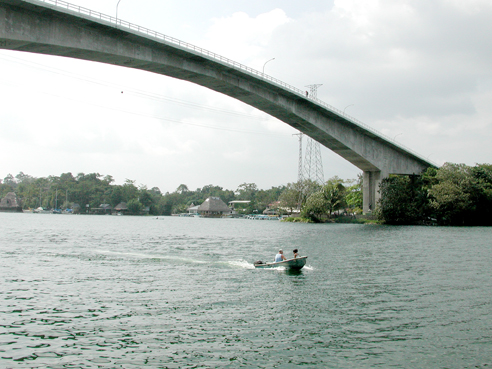 Rio Dulce is the intersection of a road running north and south, and a river running east and west. A bustling and rather seedy settlement has grown up around the north end of the very long bridge. There are numerous docks, restaurants, bars and boat-related businesses catering to the yachters who sail up the 25 miles from the Caribbean. Some are just visiting, on part of a longer trip. But many more live here at least for part of the year.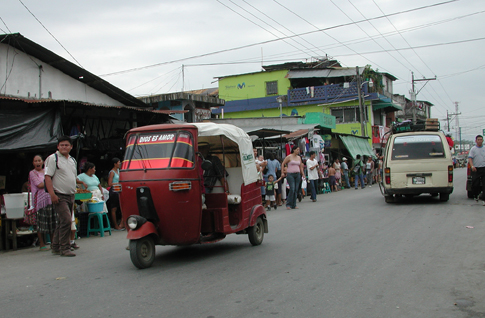
The boat people are quite different from the travelers one meets in other parts of the country. I suspect the boat people in Rio Dulce, particularly the regulars, are different from those in more upscale destinations, too. Like the port, many seem a bit seedy themselves. There are some real characters, and it doesn't take much to start a stream of stories. (Getting them stopped, however, can be a challenge.)
Most of the activity around Rio Dulce is related to boats and the river, but about an hour away by bus along a dirt road is a marvel I had heard of, but had never been to--a hot waterfall. Anna Colleen and I decided to check it out.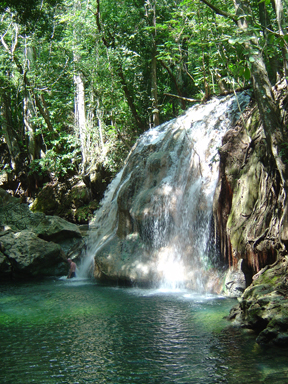 The waterfall turned out to be one of the most amazing things I've ever experienced in Guatemala. Hot water cascades down an embankment of rocks, thick with mineral deposits, into a pool of cool water. It was the mother of all hot showers. As we bumped along on the way to the waterfall I said to Anna Colleen that I hoped the ride was worth it. As I stood under the waterfall, the hot water pounding on my back I thought to myself that it may be worth the price of a plane ticket. It was that good.
The next day we left Rio Dulce to go down the river to the town of Livingston at the mouth of the river. Livingston is pure Caribbean, very different from the rest of Guatemala. It is only reachable by water, either down the river or across the mouth of it from the port of Puerto Barrios.
We spent just a night there, then took the boat back up the river the next day, back to Rio Dulce. Overnight is usually enough in Livingston; the best part is the trip on the river.
Anna Colleen left today to go back over to the highlands. She is meeting a friend of hers who will be coming to Guatemala for the first time. With her experience of the past couple of weeks she is almost a veteran traveler here and will, I'm sure, be a good guide for her friend.
I intend to spend the next few days on a remote beach a few miles from Rio Dulce, along the southern shore of Lake Izabel. I have a new book and the place I will stay has hammocks. Sounds perfect.
contents copyright ©2005-2009 Jim McCluskey