




Tuesday, March 25, 2008
Here Today, Gone Tomorrow
Today is my last day in Guatemala; tomorrow I fly back to the States, and expect to be home a few days later.
I can tell it is time for me to leave because there are things annoying me that probably shouldn’t. The latest example is the color of the room I am staying in tonight. The bottom half of the walls is a particularly unpleasant shade of green, with some blue in it but not enough to be teal. The top half of three walls is baby blue, and the top half of the fourth is sunshine yellow. The ceiling is white but so textured it looks like a cottage cheese factory exploded. I guess I shouldn’t expect too much for $4.50.
On the plus side, a few feet outside my door there is an aviary with a dozen or so birds, including mourning doves. (That is a plus for me, of course, not the birds.) The cooing of even caged mourning doves is quite pleasant. I may change my mind if they keep it up all night.
The past week has been if not always enjoyable, at least interesting. The week before Easter,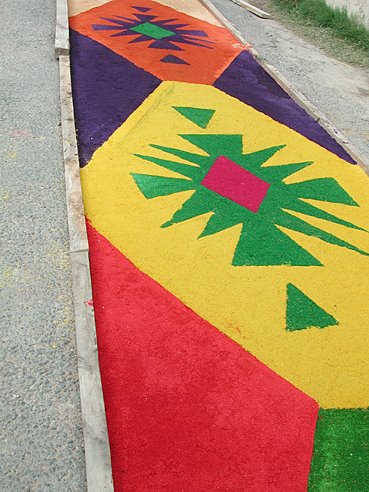 Semana Santa, is celebrated in many places in Guatemala with religious pageantry and the famous alfombras, carpets made of colored sawdust, and sometimes flower petals, covering streets. They are mostly of a religious theme, but some are in geometric patterns.
Somewhat like Tibetan sand paintings, the alfombras are colorful, intricate and time consuming to make—and don’t last long. They are constructed early in the day, and later the same day a procession tramps through it.
I believe the point of the Tibetan creations is to illustrate the transitory nature of life. I suspect the alfombras are meant to convey the message that no matter how hard you work, it’s going to look like crap before long.
I spent most of Semana Santa in Panajachel, on the shore of Lake Atitlan. Pana is a year-round vacation destination for 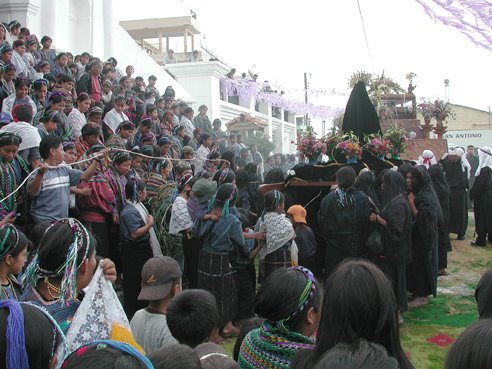 foreigners, and during holidays, Guatemalans. Though there was some religious pageantry, it competed with a decidedly secular atmosphere that was quite a bit like Spring Break on San Padre Island. Massive quantities of alcohol were served from ad hoc street stands to hoards of drunken Guatemalan adolescents (a state that persists well into middle age among a certain class).
On Good Friday I left Pana and spent most of the day in the village of San Antonio Palopó, on the lake a few miles away from Pana. I have friends there from the several months Faye and I stayed in the village over the course of a few years. Of the towns around the lake San Antonio is probably the most unaffected by tourism. It does a very good job with its alfombras and procession, and I was nearly the only foreigner there to see it.
I spent the weekend in Xela, Guatemala’s second largest city, where my godchildren live. The city was nearly a ghost town. Evidently anyone who could get out of town to the beach or somewhere had left. After the chaos of Pana it was a real relief.
On Easter Sunday I went with Alva, an aunt of my godchildren, and her two young boys and lump of a husband to a thermal water recreational facility. For years she has talked about taking me there. So, of course she finally gets around to actually doing it on Easter Sunday. Bad idea. We drove for more than an hour out of the city, then another half hour on a dirt road and finally came to the place, which was packed with hundreds of Guatemalans. I was the only gringo there. I felt very tall and white.
There was one fairly conventional swimming pool, packed with mostly adolescent boys, and several smaller pools about 12 feet square. One was being used for baptisms, but the others were pretty much just big bathtubs. Guatemalans bathe half clothed (or half naked, I guess you could say, depending on whether you were a pessimist or an optimist). Whole families were crowded into the pools with soap and loofahs, scrubbing their naked top halves and groping around in their clothed bottom halves.
I’m sure it would have been a priceless cross-cultural experience, but I decided I didn’t really want to join the crowd of bathers. Alva and family didn’t either. As we left she noted that when it wasn’t a holiday the pools were very nice. Too bad she didn’t think of that sooner.
So, that’s it for this trip. Back to reality—or what passes for reality in my life.

Wednesday, March 19, 2008
Bird's-eye View
As far back as I can remember I have had flying dreams. And not just flying, but takeoffs and landings. When I was younger sometimes I felt a little apprehensive in the dreams, particularly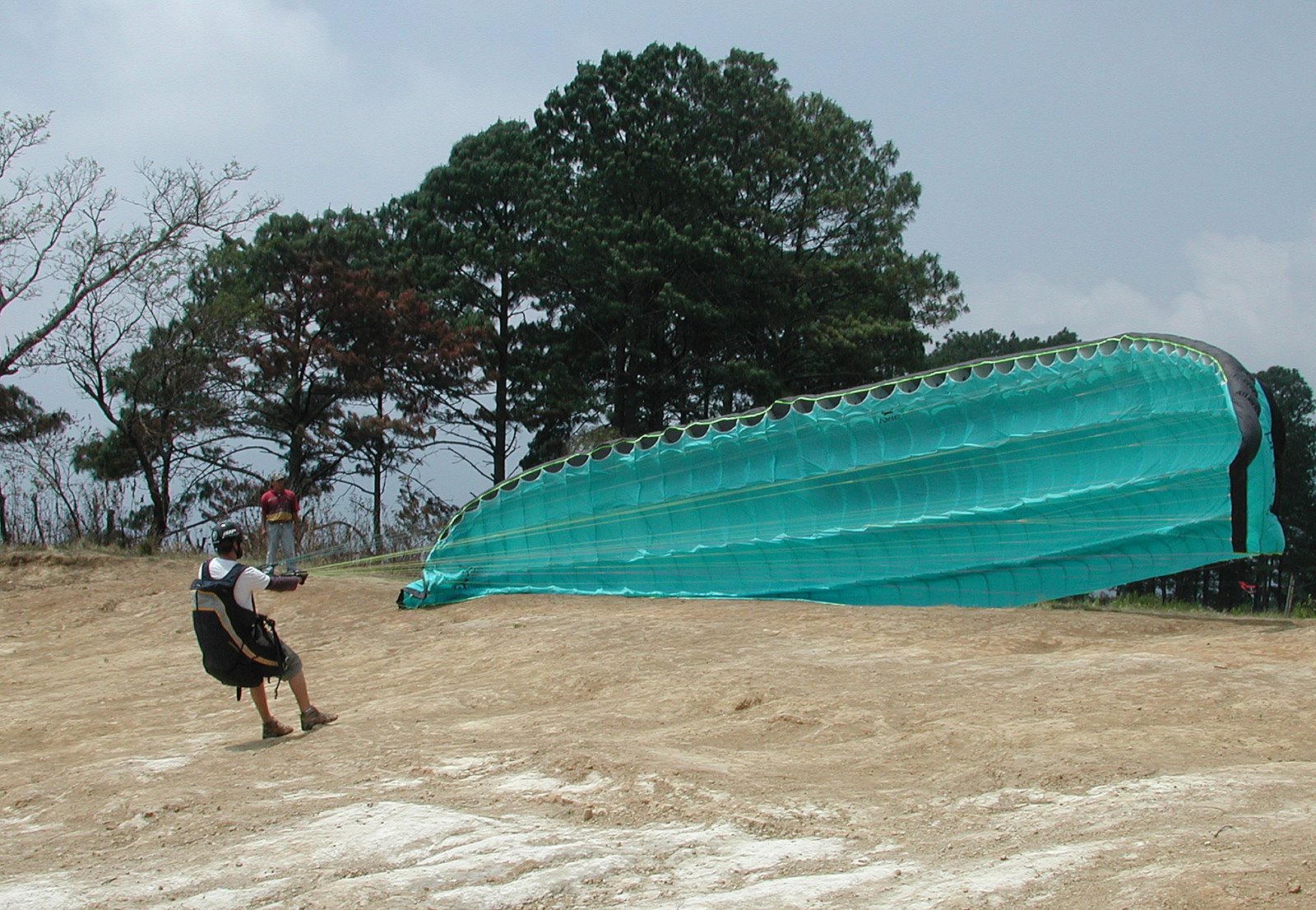 about landing, but overall the dreams were enjoyable. The more I had them, the better I got, as if each dream was a practice session. And for many years my flying dreams have felt exhilarating, with no apprehension at all. I have no idea what they mean, if anything.
A few days ago, I got the chance to go flying for real. An Aussi guy named Pete staying at the same hotel I am travels all over the world with a paraglider—sort of a parachute-like wing that packs up into a compact 60 lb. backpack. A group of paragliding enthusiasts—a club, sort of—join him in various places and he handles the logistics, such as lodging, transportation and finding launch and landing sites.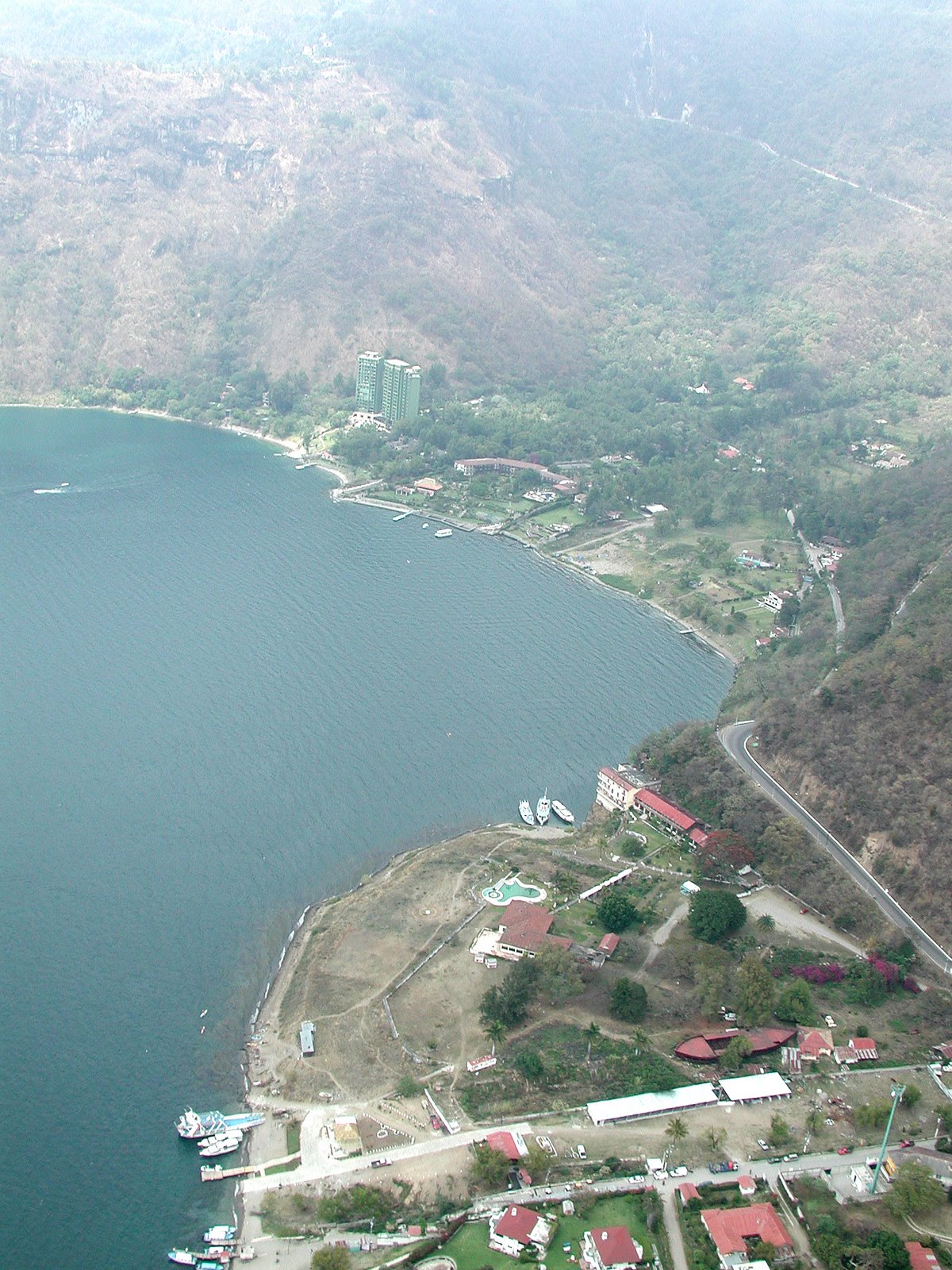 Most wings are for just one person, but Pete has a tandem rig; both people are seated quite comfortably about 20 feet below the wing, connected together by some webbing and stainless steel hardware. The “passenger” doesn’t really have to do anything except enjoy the view.
I had seen wings in the air over Lake Atitlan, but had never talked to anyone with their own equipment. When Pete invited me to go flying I knew I had to try it, since I had been practicing in my dreams for so long.
A driver took us up to the top of a cliff near the lake, Pete got the wing all laid out and both of us strapped into our harnesses. Then we took a few steps forward to pull the wing into the wind. After a few tries the wing inflated just right and lifted us off the ground—and we were flying.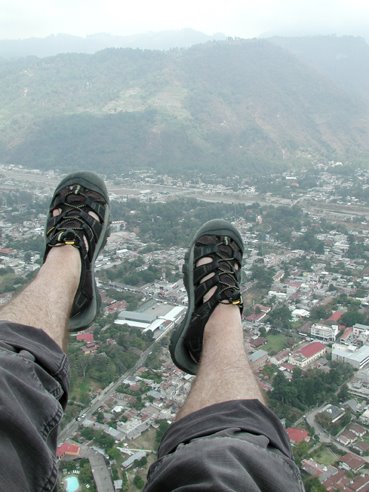 We soared out over the cliff face, and over the village below at the edge of the lake. We looked over and down at buzzards taking advantage of the same thermal updrafts we were.
Oddly, but not surprisingly, flying in the paraglider felt remarkably familiar, and completely enjoyable. There was certainly more equipment involved than in my dreams, though the paraglider is about as minimalist as can be. And I felt a little motion sickness (I looked for potential targets below). But other than that I felt like I had been there many times before. At the end we floated into the landing site, took a couple steps and that was it. All the practice paid off.
Friday, March 14, 2008
The Old and the New
To those unfamiliar with Guatemala it is difficult to convey what the country is like. There are the iconic weekly markets held in every village of any size that are a feast for the senses. And the psychedelic painted buses chicken buses that haul people, products and yes, poultry to and from nearly every place in the country, especially on market days.
There are villages, towns and cities constructed almost entirely of concrete block, with buildings often left crudely unfinished, by our standards anyway, or painted in bright, unattractive colors. Advertising and political logos seem to be a pervasive design motif.
Patchwork cornfields cover mountainsides and nearly every bit of level ground in rural countrysides. Depending on the season the fields will be thick with growing cornstalks, or barren with men cultivating the ground with heavy hoes, no doubt in much the same way as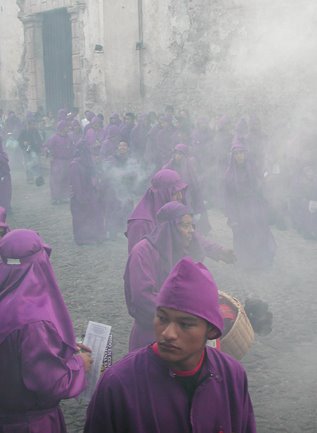 they have for centuries.
The biggest event of the year—Semana Santa, or Holy Week—is next week, culminating in Easter Sunday. In many towns around the country, most notably Antigua, there are already colorful religious processions. Not being Catholic myself I am not quite sure what most of the processions are supposed to represent, but they are quite a spectacle. I suspect they are also a health hazard; sometimes the smoke from burning copal incense nearly obscures the view of the procession.
It’s all good, but sometimes one yearns for something different. Last weekend was the third annual music festival in Santiago Atitlan, on the far side of the lake from Panajachel, where I spend most of my time. The festival was nominally a benefit for a local hospital that was damaged by Hurricane Stan, but it was also just a good excuse for a party. Nearly 20 groups, from a couple of indigenous Mayan bands, to bluegrass, hip-hop, rock and several flavors of jazz, played for more than 12 hours. It reminded me of some of the music festivals from back home. The caliber of musicians around here, both Guatemalans and expats, is a lot better than one might expect to find in a third-world country. I was very impressed and surprised.
An even bigger surprise was when British rocker Brian Howe, formerly of Bad Company, 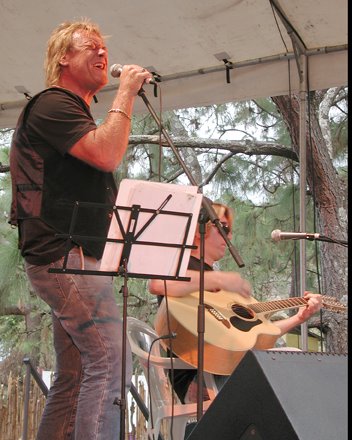 showed up with his guitarist. Everybody was just shaking their heads trying to figure out how he had dropped in on the festival. He was funny and it seemed he also was wondering what he was doing there. I ran into him on the street the next day and talked to him a little. He said he liked it around Lake Atitlan and was looking at buying a house.
The festival lasted until midnight. The boats were no longer running back to Panajachel where my hotel room was, so I spent the rest of the night huddled around a campfire with a dozen others who also had not thoroughly thought through the situation beforehand. I hadn’t pulled an all-nighter since my youth. Doing it this time did not make me feel any younger.
The upcoming Semana Santa festivities in Panajachel probably won’t be making me feel any younger either. Where Antigua is known for its traditional religious processions during the week, Pana is known for its drunken revelers, mostly young people up from Guatemala City. I probably would go somewhere else for the week just to avoid the scene, but on Good Friday I want to go out to the nearby village of San Antonio Palopó where the celebrations are quite traditional, colorful and a lot more low key than Antigua. If I give up my room in Pana it is not likely there will be a vacancy anywhere in town during Semana Santa. There will probably be plenty of people sleeping in the streets, but I’ve had enough of that for now.
Tuesday, March 04, 2008
The Dental Tourist
I am doing something I never thought I’d do in Guatemala—I am getting dental work done. Several months ago a big chunk of a molar broke off during a poker game. (Maybe I grind my teeth when I am holding a bad hand.) The tooth didn’t hurt so getting it fixed wasn’t an emergency. But it was only a matter of time before the rest of it crumbled. I needed a crown, but at a cost of more than $1000 in the US, that was out of the question. Getting it pulled was more in my price range, but I was reluctant to do that.
I often read the travelers’ forums on the Internet related to places I go (and would like to). In a forum on Guatemala I read some people’s fairly positive accounts of dental work in Guatemala. That came as a big surprise to me. In most of Guatemala, especially in the rural areas, dentistry consists mainly of extraction. I’ve seen long lines of people waiting to have teeth pulled, and I’ve seen a lot of people missing most of their teeth. That is not the kind of thing that inspires confidence. A step above guys with pliers are the dentists who specialize in gold inlays. It seems to be a fashion statement to have stars or even initials embedded into the front teeth. (Lest one be too quick to judge, the Mayas have a long heritage of dental inlays. In the old days the inlays were jade instead of gold. I think the initials are a recent innovation.)
I'm not ready to go for the inlays, but according to what I read there were dentists here who know how to do regular dentistry. So last week I started seeing one who was recommended, a woman. (For some reason there are quite a few women dentists in Guatemala; I don’t know if any in the US though I am sure there are at least a few.)
The ambience of the dental office, and the process in general, seemed quite a bit more casual than in the US. The “office” actually was more like a living room with a couple of dental chairs for furniture. I’m not sure what the second chair was for, since there was only the one dentist. I suspect it was like people who leave their old cars parked beside the house when they get a new one. It looked home made, upholstered in purple plastic.
The chair I was in, as well as the rest of the equipment, while professional, looked like something I remembered from my childhood, which was very disturbing. I had some very bad memories. For some reason as a child I was afraid of having a needle stuck into my gums. I was prone to a lot of cavities and until my teens my very patient dentist filled my teeth without the benefit of anesthetic. Years later a brother-in-law, who is an excellent and modern dentist, assuaged most of my fears, but I didn’t have the same degree of confidence in my Guatemalan dentist, especially after seeing her retro setup.
She was actually very nice and, as far as I could tell, competent. She seemed more motherly than professional, which I had mixed feelings about. One desires to be comforted in such situations. As she worked she pressed her motherly bosom against my head, but it was not as comforting as I might have expected. For one thing the anesthetic she injected into my gums made the side of my face numb, but seemed to have missed my molar. As she drilled my childhood experience came flooding back. If the arms of the chair had not been of hard plastic I am sure the imprints of my fingers would still be there.
(An acquaintance here was telling me about a dental experience he had in Calcutta, India. His dentist didn’t use any anesthetic and kept imploring him to “stop kicking.”)
Anyway, the bottom line is that a crown costs a quarter of what it would cost at home. It is a silver alloy instead of gold; a porcelain-covered version would have cost about $20 more. Though the workmanship may not be as good as some of my existing crowns, as far as I can tell it is fine and will serve me well.
contents copyright ©2005-2009 Jim McCluskey