


Saturday, September 19, 2009
On to Ontario.
We have reached Eastern Ontario, where Faye grew up, where one of her brothers lives, and where we will stay for a while.
Against the advice of several people, rather than taking the direct route to southern Ontario, through the US, we continued eastward from southern Manitoba into northern Ontario. (Yes, northern Ontario is due east of southern Manitoba, and is northern only in relation to the southern part of the province, which extends quite a ways south, to about the same latitude as central Oregon.)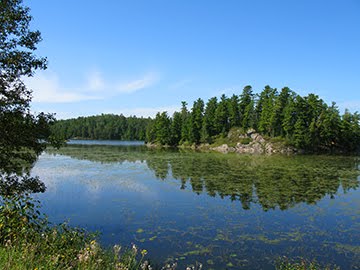 “It is all just trees, trees, trees,” we were told. But it was also lakes, lakes, lakes, and was absolutely beautiful. Driving through hundreds of miles of trees we passed scores of lakes of all sizes, many dotted with tree-covered islands. The drive along the northern shore of Lake Superior was particularly nice, sometimes with clear vistas out across the lake and sometimes skirting coves and inlets. (There were more than 300 miles of that!)
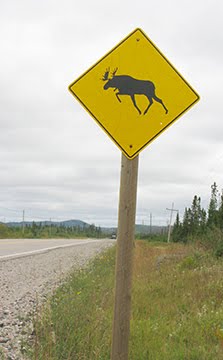 We saw numerous signs warning of moose on the highway, but we didn’t see any. In fact the only notable wildlife we saw were some lake otters scampering across the road from one lake to another. Being surrounded by forest for so many miles, I was surprised we didn’t see more animals.
We left Lake Superior at Sault Ste. Marie, continuing eastward towards Ottawa (capitol of Canada, for non-Canadian readers) and drove along the Ottawa River. On the northern side of the river is the French Canadian province of Quebec.
Though Canada is officially a bilingual country—virtually all packaged goods are labeled in both English and French—in the western provinces there is little recognition of it. In fact, the only officially bilingual province is New Brunswick, one of the country’s eastern, coastal provinces. Quebec’s only official language is French.
But beginning in eastern Manitoba we started seeing more French language signs alongside English signs, and even heard French commercials on English radio stations. (There are French language radio and television broadcasts across Canada.) Winnipeg has a large French-Canadian population, and there is a section of the city that is entirely French. Here in Ontario we are hearing more French spoken (which, unfortunately, we can't understand.)
We’ll be visiting Quebec a little later, which, I’m sure will be interesting. In some respects Quebec is like a different country—and there are plenty of Québécois who think it is a different country. 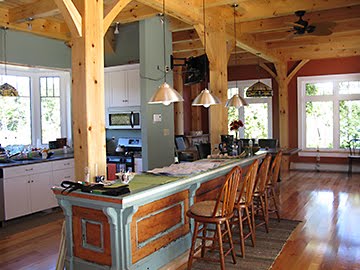 But for now we are spending some time in Ontario with one of Faye’s brothers, who is putting some finishing touches on a new “cottage.”
I put “cottage” in quotation marks because in Ontario the term “cottage” evidently does not imply small or rustic. Faye’s brother’s place is a beautiful and spacious timber frame house nestled in the woods overlooking a lake. It is an idyllic place in a mesmerizing location. But I think we could get used to it. There are plenty of little projects left to do to keep us occupied when we grow weary of cottage life.

Tuesday, September 15, 2009
Land, Lots of Land
Canada’s prairies, stretching east from the Rockies in Alberta, across Saskatchewan and most of Manitoba, are a lot of not much, surrounded by next to nothing. I think the prairies are the kind of place you either love or hate, and I loved it. There are vast fields of wheat, some of it harvested, some waiting to be threshed. 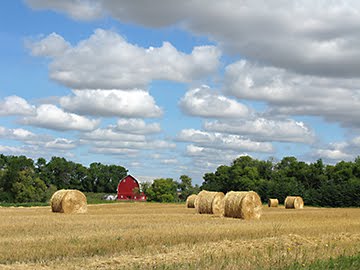 Giant round bales of hay lie scattered in green fields, with occasional fields of corn, sunflowers and other crops. This time of year, at least, the prairies are beautiful.
Small towns are strung out along straight roads. Some are barely alive, just a name and sometimes a slogan— Stoughton: The Crossroads of Friendship; Coronach: Where the Past Meets the Present;Esterhazy: Postash Capital of the World.
Our first destination after leaving Moose Jaw (Where You Want to Be) was a pilgrimage to Canada’s most famous, yet fictional, small town, Dog River. In six successful seasons the sitcom “Corner Gas” portrayed life in the small Saskatchewan prairie town. After the series ended earlier this year “Dog River” evaporated, leaving the actual town of Rouleau (Buckle of the Grain Belt.)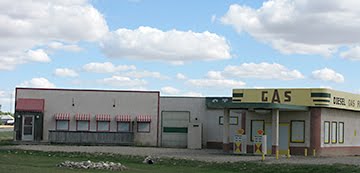 Truthfully, the visit to Dog River was one of the things I was looking forward to most on our cross-Canada trip. I wish we could have got there while the series was still being shot. There is not much there now, aside from the quiet little town that was there before the series. Part of the famous gas station and the Ruby Café is still there, though boarded up. Some of the existing buildings that were used frequently in the program are still there. The “police station” is now a coffee shop that sells souvenirs. (I bought a hat.) But I wasn’t disappointed. We saw what’s left of Dog River, and now when we watch the TV show we can recognize places.
Down the road a ways we stopped at another small town, Souris, Manaitoba, known for having the longest suspension foot bridge in Canada (but no slogan.) As we entered town we saw a couple selling homemade jams and jellies, so we pulled in. After we bought some Saskatoon berry jam and a jar of pickled vegetables we noticed we were parked in front of a little café. So we went in for lunch—homemade soup with garden vegetables, and a sandwich on homemade bread. Delicious.
We left with a loaf of bread, after being urged by the waitress to go see the swinging bridge. We did, and it was fun to walk across, and worth seeing. Getting to the bridge we drove past nice old brick homes that were testimony to a prosperous past, if not present. Souris was the kind of surprise that makes taking back roads worth it.
By evening we were in Manitoba’s only city, Winnipeg. After days on the prairies I don’t think we were ready for a city. I’m sure Winnipeg deserves a better review than I am likely to give it, so I will leave it at that. We spent one night, and part of the next day, then headed eastward into Ontario’s cottage country.
Friday, September 11, 2009
From Salmon Arm to Moose Jaw
According to Mapquest the distance between Salmon Arm, British Columbia and Moose Jaw, Saskatchewan by the most direct route, the Trans-Canada Highway, is 741 miles, and takes about 14 hours to get from one place to the other. We avoided the Trans-Canada as much as possible, instead searching out back roads, sometimes dirt and gravel. So it took us nearly 1200 miles—and nine days.
None-the-less, we feel like we have made good time. As Robert Pirsig said in Zen and the Art of Motorcycle Maintenance, the emphasis has been on good rather than time. We spent the first night camping at a hot spring (hard to beat that!) Over the Labor Day weekend we stayed with Faye’s brother and sister-in-law in Calgary, who took us places we would not have known about, including to a nearby town for a rodeo. 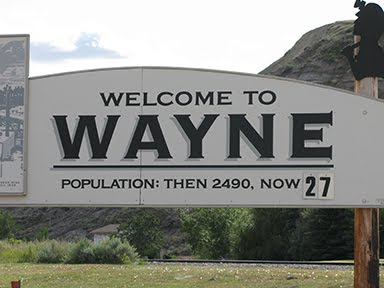 I had thought that maybe we could have a theme for the trip, visiting towns named for odd body parts, i.e. Salmon Arm and Moose Jaw, but there were not enough of them. We did wander through Wayne, Dorothy, Patricia and Millicent. But they were fairly close together and didn’t get us far. Wayne had a nice sign that said the population was 27. Millicent was so small that the name appeared only on the map. The two-lane country road that connected them was quite enjoyable, though.
Speaking of odd names, one of our side trips from Calgary was to the town of Vulcan. 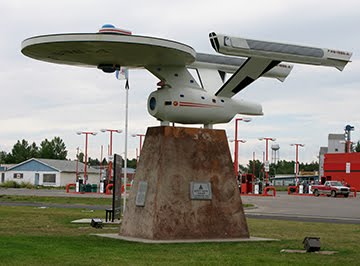 It was named a century before Star Trek made Mr. Spock’s home planet famous. But about 20 years ago, in a desperate attempt to avoid extinction, the town decided to capitalize on the name, built a model of the USS Enterprise, opened a Star Trek museum and began hosting a yearly convention.
The Star Trek museum wasn’t very impressive. But the dinosaur museum in Drumheller was something else. The badlands near the town is one of the best fossil fields in the world, with new examples of prehistoric animals exposed every year. Well-known paleontologists have excavated fossils for decades, and continue to do so. The museum is filled with giant skeletons and impressive recreations. 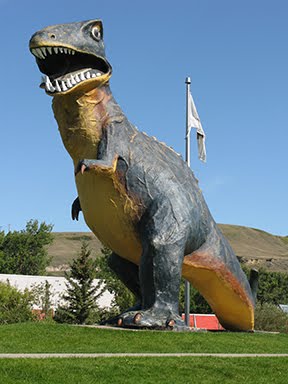 Of course the town makes the most of the area’s reputation with dinosaur statues in front of every other business, including one so big that you can take stairs up to the top and look out over the town through its mouth. Close to life size, evidently.
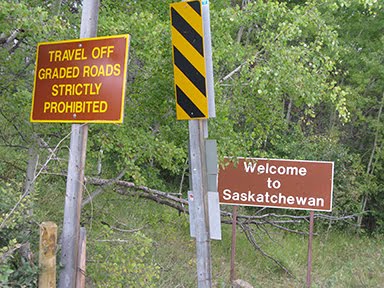 We entered Saskatchewan on a dirt road in a provincial park that straddled the border. We laughed when we saw the sign welcoming us to the province because it made Saskatchewan look, shall we say, undeveloped. However, after spending a few more hours getting to Moose Jaw, we thought that maybe our first impressions were not that far off. (Apologies to our friends with roots in Saskatchewan.) We got back on the Trans-Canada Highway and stopped at the welcome center. From the promotional brochures we read it became clear that most places in the province have a hard time finding anything to brag about.
We got to Moose Jaw late this afternoon. As far as we can tell the towns major attractions are a giant statue of a moose somewhere, and some underground tunnels supposedly used by Al Capone. We’ll visit both tomorrow before continuing our drift eastward. We’ll get on some back roads and see what we can find.
contents copyright ©2005-2009 Jim McCluskey