




Tuesday, December 29, 2009
A Slice of Pai
After Chiang Mai our next destination was a small town up in the mountains of northern Thailand called Pai.
Pai was a hippie haven back in the 70s, along with legendary destinations such as Katmandu Nepal, Goa India, Kabul Afghanistan and a few other places. There are still echoes of that era in Pai with a lot of semi-mellow neo-hippies, Thai Rastafarians, New Agers and assorted characters, not to mention restaurants with brown rice, yoghurt and good whole wheat bread.
There is a nightly street market. But unlike the other markets we’ve enjoyed so far, most of the stuff in Pai is touristy souvenirs. There are, famously, 762 curves between Chiang Mai and Pai (which left me feeling a bit queasy on the way up). That figure is printed on every medium imaginable—t-shirts, post cards, license plates and more. Sometimes Pai is indicated in a numerical shorthand; 762 (number of curves), 1095 (the highway one takes to get there) and 58130 (the postal code). I guess a t-shirt with those numbers printed on it is a cryptic way of saying “I’ve been to Pai.” If you have to ask….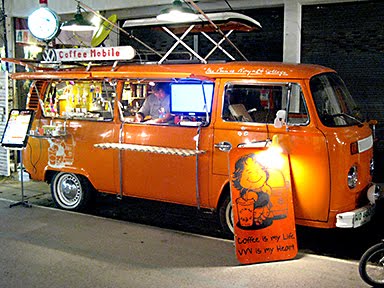
There was one thing at the market I found pretty cool; there were probably a dozen or so old VW buses that had been restored and converted into vending stands, including one that was a complete espresso shop. I almost expected to see one selling tie-dyed t-shirts and hookahs, but no such luck.
In spite of the tacky market, Pai is really a beautiful place. It is in a valley with heavily forested mountains all around. We rented a motorbike and putted around the countryside outside the town. We passed water buffalo and Brahma cows grazing in dry rice paddies, and saw a little of what rural Thai life is like. Very different from the cities where we’ve mostly been so far.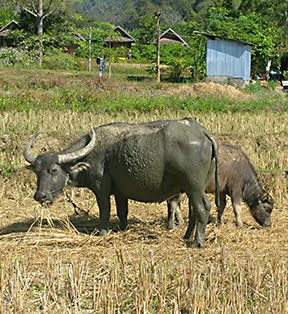
We got to Pai a couple days before Christmas. Since Thailand is a Buddhist country, except for some shiny “Merry Christmas” banners strung up on some tourist hangouts, Christmas passed largely unremarked. A few Thais, showing their cultural sensitivity, did wish us a Merry Christmas, and we had to remember it was inappropriate to wish them the same.
So, being in a country where the national symbol is the elephant, we decided to spend Christmas morning riding one. The day before we had ridden the motorbike out and petted some of the elephants available for riding; that was the closest we had ever been to an elephant, and we didn’t know quite what to expect. But the ride turned out to be an amazing experience. 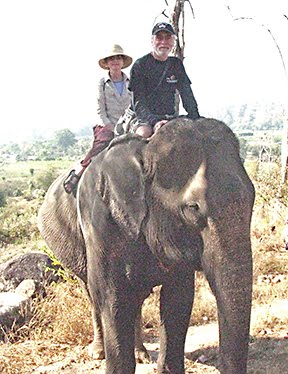
Though the Indian elephants, which are what the ones in Thailand are, are smaller than their African counterparts, there is no escaping the fact that compared to humans, they are massive. Standing next to one makes you feel really small, and climbing on top of one even more so.
Riding an elephant, or at least the one we rode, is like riding a big cow—a really big cow. (And yes, I do know what riding a cow is like. Don’t ask.) Actually, it felt more like what I imagine riding a gentle dinosaur would have been like. Our weight seemed to be completely insignificant.
We rode a 50-year-old gal named Phenomn (middle-aged for an elephant, so perhaps there was an empathetic bond between us). Along with three or four other elephants and their riders, we went out through the countryside, which was a grand way to see it.
We could feel Phenomn’s muscles ripple under our overstretched legs. I straddled her neck and tucked my knees in behind her ears, which felt like a relatively secure position; Faye sat a little further back where she could hang onto a rope tied around the elephant’s chest. From my vantage point I could look down over Phenomn’s huge head, and I patted it every once in a while, or rubbed her ears, hoping to convey some affection. Sometimes elephants and their handlers grow up together in the same family. I’m not sure what Phenomn’s history is, but she did seem like a huge family pet.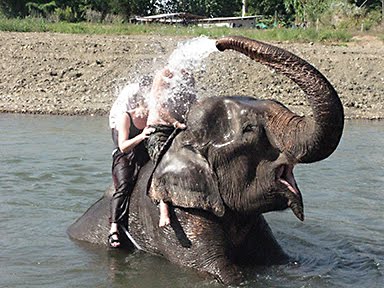 After the trek through the countryside we rode into a river where the elephants sprayed themselves, and us. And then tossed us off into the water as many times as we cared to climb back on. It is an awesome feeling being thrown into a river by an elephant. I thought of Woody Allen’s line in Annie Hall, that it was “the most fun I’ve ever had with my clothes on”—in spite of my clothes being soaking wet.
In Thailand elephants have been domesticated for centuries. I’m not sure there are any in the wild anymore. They are basically the heavy equipment of farm animals, helping to clear forests and move logs. In areas travelers visit, such as Pai, some elephant owners make money giving people like us the chance to ride them. From the elephant’s perspective, it seems like it would beat working.
Later, Christmas evening, we treated ourselves to a massage. Unfortunately we couldn’t get massaged where we really needed it after straddling an elephant all morning—it wasn’t that kind of place. It felt wonderful anyway, but Faye and I walked a bit like elephants for a few days afterwards.
We left Pai on a Saturday morning, just as hordes of Thai weekenders were pouring in, and returned to Chiang Mai. I had to get some dental work before leaving Thailand, which I’ve now done. Though that experience went pretty well as far as visits to the dentist goes, it reinforced the truth of Einstein’s observation that time is relative—an hour in a dental chair is quite a bit longer than an hour in a massage chair.
Now that that is done, we are going back up into the hills of northern Thailand. We’ve been talking to a Thai woman who owns a shop in Chaing Mai and does business with some of the hill tribes. She has told us of a couple of places that sound interesting. Whether or not they celebrate New Year’s remains to be seen.

Wednesday, December 23, 2009
Chillin' in Chiang Mai
I was going to say that Thailand is a feast for the senses. But in our experience so far it is more like diving face first into a buffet.
All the senses are indulged and stimulated to the point to where it is difficult to savor anything in particular. Sights and sounds, smells and tastes all mingle together. And if it all gets too exhausting one is never far from a row of comfy chairs lining the street with masseuses eager to rub your feet, back, shoulders or whatever. That’s about as sensual as it can get. But I am getting ahead of myself.
We arrived in Chiang Mai via sleeper train from Bangkok a week ago. We missed a lot of territory between the two cities, which is unfortunate. But we’ve enjoyed Chiang Mai so much that I know we would have regretted having less time to spend here. I don’t know how long we would have to be here before feeling that we’ve had enough, but we won’t get the chance to find out.
Chiang Mai is still a good-sized city, about a quarter the size of Bangkok at 1.6 million. But it feels manageable. Part of it, the “old city,” is surrounded by a moat. It is still a pretty big area, but at least you can walk from one side to the other in a half hour or so. Or at least you probably could if it weren’t for all the restaurants, shops and Buddhist temples to distract you.
Walking isn’t strictly necessary; there are plenty of taxis and tuk-tuks, the three-wheeled motorcycle contraptions, cruising around everywhere—and contributing to the general traffic problem. Just getting across streets can be a real challenge, but the vehicles—cars, taxis, tuk-tuks and motorcycles (there are about as many motorcycles as cars)—seem to be pretty good at avoiding pedestrians.
I mentioned sensual feasts. There are also literal feasts. Food is a big thing here. Seems like everyone is always eating, Us too. We’ve heard that travelers loose weight in Southeast Asia. But I don’t see how that would be possible in Thailand. Eating is as much, or more, entertainment as nourishment. I’m sure we could cut our food budget in half if we ate only when necessary.
We took a one-day Thai cooking class where we spent the day preparing, and eating, a several course meal. It was great fun, and at the end of the day we not only felt stuffed, but we had an appreciation for how fresh and basically simple Thai food is. We’re hoping we can remember enough to cook some at home.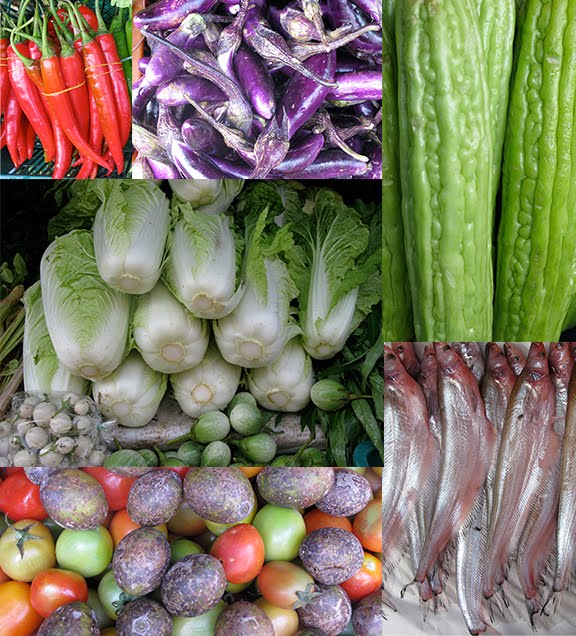 We started the class by visiting a market to get the ingredients for the dishes we were going to prepare—ginger and turmeric roots, coriander and lime leaves, lemon grass, garlic and chilies. That is what Thai’s typically do, buying a little of this and a little of that to make the day’s meals. Or at least the ones that cook at home do. With so many street vendors selling prepared food I wonder whether anyone actually cooks at home. Why would they bother?
Anyway, we shopped for ingredients, and were able to get the teacher to identify a lot of things we didn’t recognize. Just the display of the vegetables, fruits, fish and other things were very attractive. Some of the vendors prepare little bundles of the fresh ingredients for soup. Just chop it up and cook it in a little coconut milk and you’ve got Thai fast food.
There are basically two kinds of markets, the “daily” markets where one buys food and household stuff, and artisan/product markets, aimed mostly at tourists and other shoppers. In Chiang Mai there is a big “night market” every night of the week that fills the sidewalks and a few mall-type areas along several blocks. And in another part of town there is a Sunday evening market that takes up a whole street for probably fifteen blocks. Both markets get so packed it is nearly impossible to walk. For both, vendors set up in the afternoon, and sometime before morning, disappear.
There are plenty of crap vendors, but a large percentage of the things sold are of remarkable artistry and quality. With so much to see it is easy to overlook just how good much of it is. You almost have to force yourself to stop and look at certain things and temporarily ignore everything else.
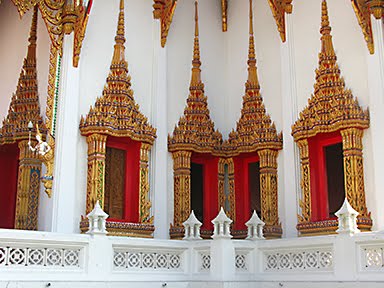
One of the most amazing and inexplicable things I’ve ever seen are the portrait artists. There were some very good ones doing quick drawings at the Sunday market. But the ones that really astound me are the ones in the nightly market who do portraits from photographs. I think they were using graphite pencils and brushes; the portraits look almost photographic. What I find inexplicable is that there are at least a couple dozen of these artists—mostly men, but a few women. I could understand one or two exceptionally talented people doing that caliber of work. But so many just defies explanation. 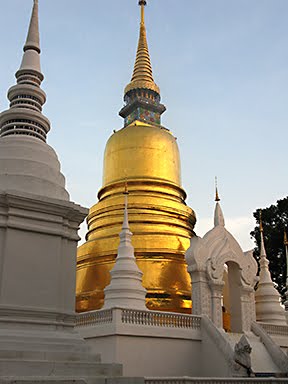 The Buddhists temples—and there a lot of them—are a visual feast, with ornate architecture and very intricate carvings covered in gold leaf. And, of course, lots of gold Buddhas.
Evidently 95% of Thailand is Buddhist, and the general outlook that Buddhism inspires is evident in the attitudes and actions of the Thai people. As opposed to the religions most westerners are familiar with, Buddhism is a very personal religion. It is focused primarily on becoming a better person, and encourages common decency towards others. That is an oversimplification, but it is the general idea.
Buddhist monks are not “caretakers of the flock.” In fact the “flock” takes care of the monks while they study and internalize Buddhist values. Thai people basically feed and cloth the numerous monks, giving them food, and voluntarily supporting the temple universities. While caring for monks is considered meritorious, becoming a monk is even more meritorious.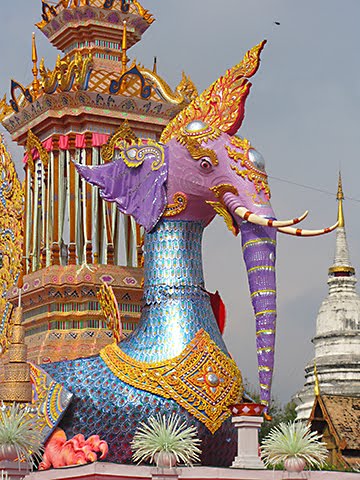
Some are monks for just a short period, perhaps as a child. Others study for several years and return to civil life as young adults. I don’t know the percentage of Thai males who are monks at some point in their lives, but it is pretty high. Even the Thai king was a monk for a while.
Of course, many remain monks for the duration of their lives. We attended some ceremonies for a venerated monk who recently died in his 90s. His remains were cremated. We didn’t see that, but his funeral pyre may have been the psychedelic flying elephant that had been built at his temple. Elephants are the national symbol of Thailand. There are elephant images and figures everywhere. But this colorful winged elephant was really something. Made me think the old monk was going to go to Nirvana (or wherever they go) with a smile on his face.
With some reluctance we are leaving Chiang Mai to go further north into the mountains, to Pai. Everyone says it is beautiful, so even though we’re sorry to leave Chiang Mai, we are looking forward to Pai. We’re going to have to come back to Chiang Mai for a few days before we go on to Laos so I can get some dental work done. Talk about mixed feelings!
Monday, December 14, 2009
A Few Nights in Bangkok
 We spent the first night of our budget trip to Southeast Asia in a Hilton Hotel…in Chicago. Our plane sat on the tarmac in Toronto for three hours waiting for the snow to let up to in Chicago, and when we finally arrived our connecting flight had already gone. We had left our winter clothing in Toronto, so we were not prepared to spend time in freezing temperatures.
The Hilton cost us three times our daily budget—even with the half off voucher given to us by the airline. Not a good start, but we’ve learned to be flexible.
In spite of continued snow flurries, and being on stand-by, we managed to get out of Chicago the next day. We flew on Japan Airlines, which was a real treat. The Japanese flight attendants were invariably perky and polite, qualities I’ve found lacking in the flight attendants on recent North American flights. At one point one offered me a spoon for the ice cream she had just given me. She bowed as I took it from her two outstretched hands.
The 12-hour flight to Tokyo, as well as the 7-hour flight on to Bangkok, was made as pleasant as one could hope for by such graciousness—not to mention three pretty decent meals, snacks between meals, complementary beer, wine and other beverages, and frequent offerings of juice, coffee and two kinds of tea. And moist, hot towels every so often. I know the folks in first class had more legroom, but I can’t imagine they were treated any better we were.
Air travel has become more and more unpleasant in recent years. On North American airlines (including Canadian) there seems to be a race to the bottom. You’re lucky to get a bag of peanuts tossed at you. It is nice to know that quality service is still available in some parts of the world.
At some point over the Pacific Ocean we crossed the International Date Line and Wednesday afternoon became Thursday afternoon. We got to Bangkok just before midnight, and by the time we got settled in our budget hotel it was about 1:00 a.m. Friday morning, though as far as our bodies were concerned it was 1:00 p.m. Thursday afternoon. We had some serious jet lag to deal with for the next few days.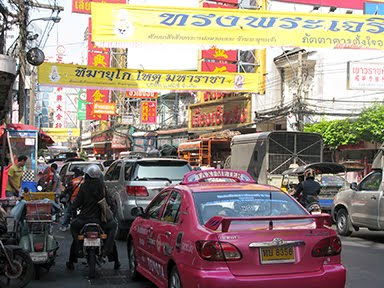 Waking up later Friday morning after what was little more than a nap, we ventured out into the city. Almost immediately we felt like we had slipped into sensory overload. The sights, the sounds, the smells—and seen through the daze of our jet-lagged eyes, almost surreal.
I didn’t expect to like Bangkok; I generally don’t care much for big cities. We had thought of it as a starting point, but intended to leave as soon as possible. But after spending a few days here we’ve changed our minds. Bangkok is amazing. Even things that should be familiar seem different and exotic.
Even from the plane, as we were coming in over the city, I noticed the first difference—vehicles drive on the opposite side of the road. 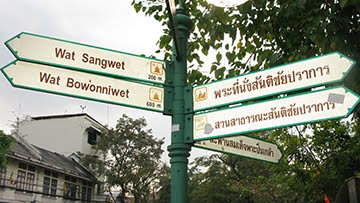 In the airport I got my first sight of Thai words, written in a script unlike anything I’ve ever seen. It is beautiful, but offers no clue at all as to how to pronounce words. Sometimes on street signs, menus or phrasebooks, there is a transliteration of Thai words, written in familiar letters. But that doesn’t usually help.
The markets are incredible, something that has to be seen to be believed. We visited one with more than 10,000 stalls covering 16 acres, selling everything you can think of—food, fine art, furniture, jewelry, electronics and probably enough clothing for everyone in the country. That much stuff in all one place just defies imagination.
Another large shopping center we went to was four and a half floors of just electronics and computers with seemingly everything except what I was looking for, a battery for my laptop. 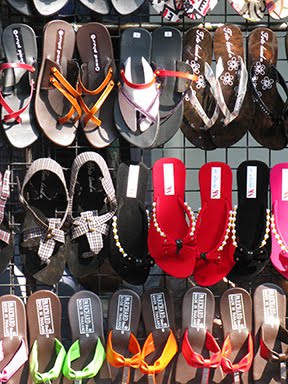 Seeing all these products, it is not hard to believe that Asians will someday take over the world, not through any evil intent, but because they work harder. Even the production of common consumables seems to be labor intensive. We’ve seen tidy rows of baked goods shaped like animals, and colorful sweets that are miniature masterpieces, almost too beautiful to eat. I know much of Southeast Asian is poor, but in Bangkok at least, there is a sense of abundance, if not excess.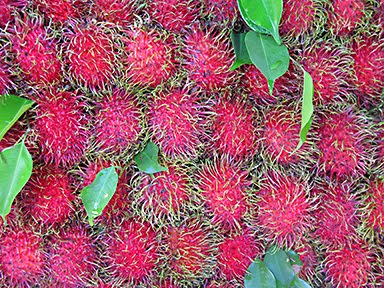
Speaking of food, I’ve never seen anyplace with as much food as we’ve seen in the markets and on the streets here. Food vendors are set up side by side nearly everywhere, many with small tables and benches for customers. In markets in stall after stall, fruit, vegetables, meat and seafood is piled high on tables or in baskets. Things slither and squirm in tubs of water. Much of it I don’t even recognize; some that I do—such as live water snakes or toads—I’d rather not.
Aside from reptiles and some other things I’m not going to touch, the food is delicious, and cheap. A good meal can be had for two dollars or less. Unfortunately a beer can cost as much as the rest of the meal. But a large mango shake costs about half that.
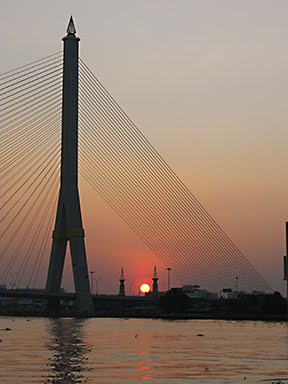
As bewildered as we felt our first morning in Bangkok, after spending a couple of days navigating to various destinations around the city we felt like we were starting to get the hang of it. Bangkok has a very good transportation system. There is an elevated rail and a subway—both quite modern. There are more than 250 bus routes. But the most pleasant and interesting mode of transportation has to be the riverboats that go up and down the Phraya River, which runs through the city. There are 30 stops, and for about 50 cents you can get on and off anywhere along the way.
Amongst travelers, particularly the “party‘’til you puke” crowd, probably the most famous destination in Bangkok is Khao San Rd., a small area packed with bars, cheap hotels, and hundreds of vendors catering to the tastes of the young and restless and wanna-be road warriors. It is a real circus, and interesting in a strange way even for the not so young. But we’re glad that we didn’t see it first thing; we would have had a very different impression of Bangkok.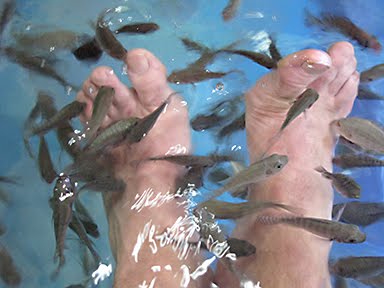
 Massage is a big thing in Thailand, and everywhere there are small places offering to rub just about anything. Faye had warned me to not even think of accepting the “happy ending” offered by some of the more, shall we say, full-service places. On Khao San Rd. we saw a place that offered “fish massage.” Sounded safe. It wasn’t exactly massage, but a pool of water you stuck your feet into and hungry little fish nibbled at them. Supposedly they eat off all the dead skin. I had to try that. I’m not sure the fish ate any dead skin, but it certainly was an interesting sensation.
As much as we’ve liked Bangkok, we are just getting started and are going to move on. Tonight we will take the overnight train to the smaller northern city of Chang Mai, a base for trekking into the mountains where the hill tribes live. We barely scratched the surface of Bangkok. Perhaps we’ll have time at the end of our trip to explore it a little more.
Tuesday, December 01, 2009
Alien Invasion
Illegal immigration has been a contentious issue in the US for the past several years, especially around election time. We constantly hear about how aliens come illegally to our country, either sneaking in the back door to the American dream, seeking a better life and citizenship. Or, and this is what we hear mostly, that they are taking American jobs, using American health care, and bringing crime and disease into the country. Neither is true for most immigrants.
In past years the money immigrants from Guatemala send home has accounted for about 10% of the money in the country. Most come to the US hoping to make some money, then return home.
But the US economy, and political posturing, has had an impact on the Guatemalan economy, and on immigrants with hopes of a better life not in the US, but for their families back home. In the last year remittances have dropped by 70%.
A couple years ago, the last time I was in Guatemala, I learned that a half-dozen or so young people I know here had gone the US to find work. One in particular surprised me because he had a wife and two children, and seemed to be relatively well off compared to most of his neighbors in his village. But, his wife said, he thought he could earn more money in the US to send back to his family. A couple weeks ago he returned and he is happy to be back. I talked with him about his experience.
He made his way though Mexico, on foot and by bus, to the Texas border. There, with about 20 others, he crossed the mountains into the US. For a fee of about $1500 he was picked up and transported further into the country where he found work, mostly by word of mouth in the network of illegal immigrants. In the two and half years he was there he worked in several southern states, mostly packing vegetables.
I asked him how much money workers were able to send home. He said that if one can find steady work, a worker can earn about $1000 a month. Those who live frugally—eating cheaply and living in housing that some farmers provide, which is often crude shelters—one can send back $700-$800 a month. (Though it is very hard to imagine someone living on $200-$300 a month under any circumstances.)
More typically workers are able to send back half or less of what they make. He said he could make as much at home in Guatemala, and be with his family. But by the time he figured that out, he was stuck there trying to earn enough to pay for his travel expenses and enough to make the trip worth it.
For others the choice is not quite as clear. Manual laborers in Guatemala earn about $6 a day.
Another friend made it to the US, worked for six months—just long enough to pay his expenses—and came back. His story was similar, of a dangerous trip—riding freight trains through Mexico-- and hard work, low wages and poor living conditions after he made it to the US.
After telling me about how much he disliked working in tobacco fields, he was eager to show me the two souvenirs he had brought back—a picture book of North Carolina, and a book about barbecue. Evidently he had some fond memories of some southern cooking. He also asked me whether I had ever seen a Wal-Mart. That impressed him too.
As I mentioned before, the father of my godchildren is currently working in the tobacco fields of South Carolina, and has been there about a year. He works with about 60 other Guatemalans, all illegal, who sleep together on beds set up in a farm warehouse. He has told his family that he plans to stay for five years, but he may change his mind. Work in the tobacco fields, in addition to being very difficult and unpleasant, is dependent on the weather. Work is not steady and he has been unable to send much money home.
So that’s the reality of the life of at least some illegal immigrants. I suspect most have similar stories. It isn't what a lot of immigrants expect, nor is it what a lot of Americans think it is. It is a lot worse than either. The beneficiaries of the system—and the employment of illegal immigrants is more of a system than most realize—are the owners, who get people willing to do the work for low wages, and the American consumers, who get tobacco, produce, meat, construction labor, yard work, restaurant meals, manufactured goods, and more—at “reasonable” prices.
Think about it next time you hear a politician or right-wing pundit pontificating on the subject.
On a completely different subject, this is my last post from Guatemala this year. In a couple days I’ll be flying back to Toronto to pick up Faye, then we’re off to Asia. Look for an update from there in a couple of weeks.
contents copyright ©2005-2009 Jim McCluskey