



Friday, October 16, 2009
Surf and Turf
I’ve been fascinated by the history of Eastern Canada and the Atlantic provinces. There are old buildings with dates I’ve seen only in history books. In places entire neighborhoods, perhaps out of simple neglect, have survived urban renewal and look like a set for a historical drama. If only they could talk.
Whispered stories fill the air in small cemeteries scattered around the countryside. Some headstones have little more than a name and date. Some hint of tragedy and the harshness of life a century ago; other inscriptions suggest an intriguing story such as the woman who, after one husband died “after an illness of 14 days”, married another man of the same last name, perhaps his brother.
The history of Acadia, as Nova Scotia was called by its original French settlers, is particularly interesting. The French and English fought numerous battles for control of the area in the 1600s. The English eventually prevailed and the territory became known as Nova Scotia (New Scotland).
There are still remnants of Acadian houses, and even some settlements populated by the descendents of the first Acadians. But in the 1750s the English expelled many of them. Some migrated to the territory of Louisiana, which was French at the time. There, the Acadians became known as Cajuns, and still speak a French dialect today.
The oldest permanent settlement in Canada is Annapolis Royal, near the southern end of Nova Scotia, founded in 1610. The French had built a settlement nearby a few years before, but it was destroyed by the English.
We took the three-hour ferry ride across the Bay of Fundy from St. John, New Brunswick, to Digby, a few miles from Annapolis Royal. The cold rains that had started a few days before had let up, and the day was fairly sunny and calm. The barf bags scattered around the ferry indicated that some crossings were not so smooth.
Had the water been rough we could have driven from New Brunswick. Nova Scotia is connected to the mainland by a narrow strip of land at its northern end. I’m sure within a century or two the Bay of Fundy will become the Strait of Fundy and the province will be cut off. Or, more likely, the waters of the Atlantic will rise and accomplish the same thing in a much shorter time.
We spent the first two nights near Annapolis Royal with Faye’s former mother-in-law, a very nice woman with a charming English accent with whom Faye has remained friends. She and her daughter’s family live in the country near the water where there are still remnants of dikes built by Acadians. Just down the lane is a small cemetery with headstones dated as early as the late 1700s.
In the early days Nova Scotia became a center for boat building, sea trade and fishing, particularly for lobster. Fishing is still a major occupation. (Nova Scotia is the only place I’ve seen lobster burgers on restaurant menus.) 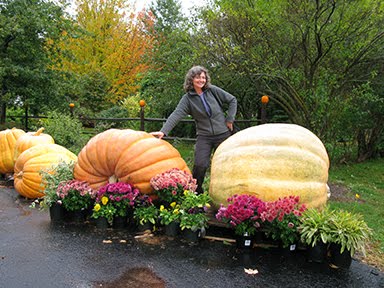 Inland, there are fields as fertile as the sea growing, among other things, pumpkins big enough to climb into. Every year in the fall there are pumpkin boat races near Halifax, where hollowed out pumpkins are paddled across the harbor.
We didn’t spend as much time in Nova Scotia as we would have liked because of a cold drizzle that came and went. We stayed near Halifax one night and explored the city for most of the next day (unfortunately a Sunday). Halifax reminds me of a smaller version of Boston, probably because it dates from the same era, with historic old buildings of a similar vintage. The oldest Protestant church in Canada is there, built in 1750, still a magnificent building. There is a plaque in the church commemorating two sailors buried there who were killed in a battle against the American warship The Chesapeake in 1813.
By the time we got back to New Brunswick the sun had returned and we took some back roads to the area where the more respectable, English side of my father’s family settled. I found the grave of my great-grandmother, who died in 1900, and mention on a monument of a great-great-great grandfather who was one of the first settlers in a small community founded in the late 1700s. There were others to whom I am sure I am related, but it will take some more work to figure out exactly how.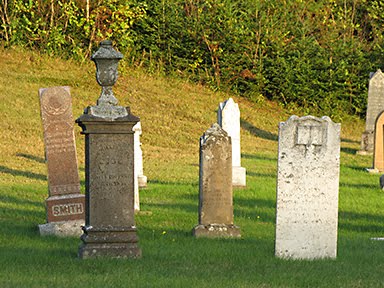
I’ve always thought cemeteries were interesting, but wondering through the graves of my ancestors was quite an experience, enough to make me feel at least partly Canadian.
We had hoped to visit Quebec City and some other parts of the province on the way back, but decided we’d return again earlier in the season when the weather was better. Instead we drove straight through from western New Brunswick to Faye’s brother’s “cottage” in Ontario.
So, the cross-country Canada part of our trip is over (except for the part next spring when we drive back to British Columbia), but it was just the first leg of our journey. The next part will be something completely different. Stay tuned.

Wednesday, October 07, 2009
Roots
As much as we enjoyed Quebec, we looked forward to getting into New Brunswick and being able to read road signs again. As Canada’s only officially bilingual province, signs are in both languages. At least it gave us an opportunity to learn what the French signs in Quebec had been trying to tell us.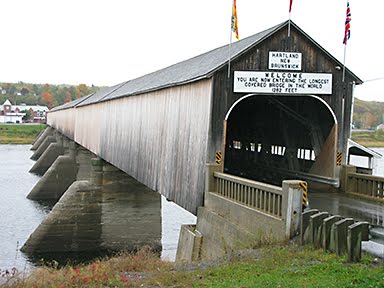
In spite of having been to New Brunswick years ago on a quick trip with my parents, I didn’t have a clear impression of what it was like. Like the countryside of southern Quebec, there were beautiful rolling hills covered with trees in fall colors.According to brochures, the province is known for its covered bridges, and we crossed the longest one in the world. 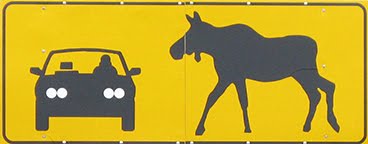 And according to road signs, we were to keep our eyes open for giant moose, bigger than cars.
I had more of a reason to want to visit New Brunswick than just the usual sightseeing. My father’s side of the family lived in the province in the 1800’s. My father was born in New Brunswick in 1904, shortly before his family picked up and moved to California, leaving little trace behind. I hoped to fill in some blanks in my knowledge of family history, and even more, find some official record of my father’s birth.
My father’s family was Irish on his father’s side and English on his mother’s. My grandmother’s family fled to Canada after the Revolutionary War, and came to an area settled by Loyalists who had been given land grants by the British Crown. (Though they were known as “Loyalists” in Canada, in the US the revolutionaries thought of them as something else.)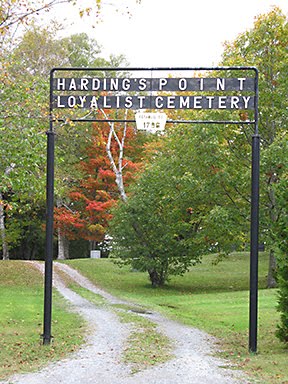 My father’s father’s side was Irish, and came to the area a little later. Though my grandmother’s genealogy is pretty well documented, I don’t know much about the Irish side beyond my great-grandfather, who was born in 1824 near where my father was born 80 years later.
Genealogical research is a lot like detective work, digging up little clues in various places, hoping one will lead to another. Fortunately with the internet, research has been easier, and some cousins have done a lot of work. But there were still plenty of questions to be researched. We poured through historical archives, visited several cemeteries and, most interestingly, were able to meet with some of my living relatives, including a 96-year-old cousin.
After a fascinating evening of listening to tales I realized that unlike my Loyalist English grandmother’s lineage, which is pretty distinguished if you go back far enough, in my Irish grandfather’s lineage there is little to brag about. There were some “characters,” to put it politely, but my aged cousin cautioned me, “This information is just for the family.” I promised.
Saturday, October 03, 2009
La Belle Province
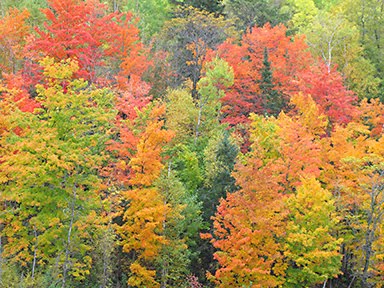 After spending two tranquil weeks in relative splendor at Faye’s brother’s lakeside “cottage” we are continuing our journey, across eastern Ontario and Quebec. As before, we’ve avoided the urban areas as much as possible and have tried to stay on rural roads (not too hard to do in Canada). The flamboyance of fall has engulfed the countryside. The scenery has been spectacular.
It is hard to say which part of the trip we’ve enjoyed more; every place has had its charms. The rugged mountains and forests of B.C. are impressive. The open prairies felt fertile and peaceful. Ontario is full of charm and history, from small towns with houses built of limestone and brick to the magnificent nation’s capitol of Ottawa.
But Quebec is special. It seems like the kind of place we could easily spend weeks, or more. One town in particular had us both thinking we should pick up and move there, at least long enough to learn French. (Various places on this trip I have said “I could live here.” And Faye says “Remember, they have real winter here!” )
Speaking of French, it was a bit of an eye opener for me to realize that Quebec really is a French-speaking province. Spoken English was rare enough that when we heard anyone speaking it, we poked each other and raised our eyebrows. Written English was nearly non-existent. It took a while to get used to the fact that I couldn’t read anything.
For me, as an American, Canada is a foreign country, of course. But it doesn’t feel foreign, just a little different. Quebec, on the other hand, really did feel foreign. Mainly because of the language, of course. But with language comes culture, and it seemed to have a certain panache. Even mundane interactions felt a little exotic.
Quebec has been agitating for sovereignty for the last 60 years. The issue is the open sore of Canadian politics. Bringing up the subject is the surest way to get Canadians to argue about something. There are compelling views both for and against Quebec becoming it’s own country, but being there it wasn’t hard to think it already was. It certainly has one foot out the door. On the other hand, it probably never had more than one foot in the door to begin with. It has a complicated history.
I think the high point of our eastward trip through Quebec was something that would have seemed exotic in any language. We dropped into a Benedictine abbey located in the forest outside a little town for the mid-day Mass. The monks sang Gregorian chants in 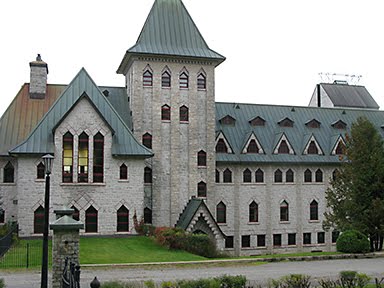 Latin, and other parts of the service in French. Since both languages are equally unintelligible to me, it was a very enjoyable musical experience, without any theological quibbles I might have had with the meaning of the words.
The monks support the abbey by making a wide variety of very good cheese. We bought a couple of small packages for our lunches, but we may have to go back for more on our trip westward.
We have moved on to the beautiful maritime provinces of New Brunswick and Nova Scotia, but I will save that for the next post.
contents copyright ©2005-2009 Jim McCluskey