




Wednesday, January 31, 2007
Going Green
Due to circumstances beyond my control, as so much here is, I did not meet Anna Colleen at the bus station in Guatemala City. I arrived a good two hours later than I planned to, and when I got there she was nowhere to be found. I could only imagine what had gone through her mind as she presumably waited for me, alone in a strange city.
Fortunately, there was a hotel next door to the bus station that had internet access, and, resourceful person that she is, she had the presence of mind to send me an email with her plan, which was to go on to Coban without me and hope I caught up. I am proud to say that I had the presence of mind to think she might do that, so I checked my email--probably on the same machine that she had written her message--and sent her a short note to let her know I got it.
As it turned out, she had left the station only minutes before I finally got there. I caught the next bus to Coban, and when I arrived I got a room at the motel she told me she was going to. She found me a few minutes later (relaxing in a hammock) after she had returned from checking her her email. Gotta love the internet. I don't know about Anna Colleen but I felt rather proud of our travel savvy.
There is little reason to spend much time in Coban, so the next day we continued on northwards to the small town of Lanquin. As far as scenery goes, the area north of Coban and around Lanquin is the prettiest I've seen anywhere in Guatemala. Roads wind through rugged mountains, which are softened by lush vegetation. The climate is sub-tropical, and evergreen and deciduous trees grow side by side with palm and banana trees.
The pavement ends miles before Lanquin, which gives the impression that it is much further off the beaten path than it really is. Sometimes from the road we could see clusters of small houses in distant valleys and I wondered about the lives of the people who lived there.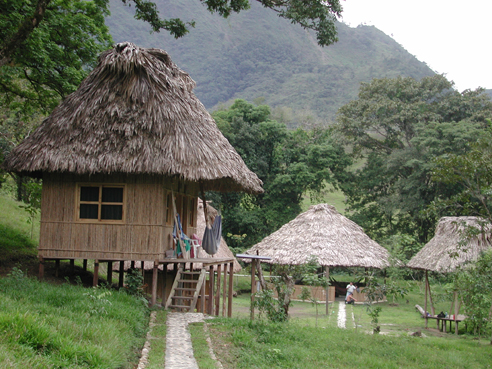 The place we stayed, El Retiro, is described in the guidebook as "sublimely located." That is certainly true. It is sort of an eco-village, a collection of thatched huts and a large restaurant/hangout bungalow situated at the edge of the Cahabón river. On the far side of the river goats graze on the steep hillside. We ate the evening meal, served family style on long tables, among travelers of many different countries. It is always interesting not only to hear tales of where other travelers have been, but to learn about their home countries as well.
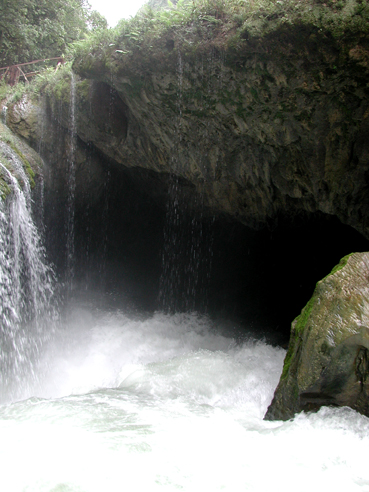 The main reason most people come to Lanquin is to visit the pools of Semuc Champey. About ten miles above El Retiro, up a bumpy dirt road, the Cahabón river flows through a large canyon. At one point the river cascades violently into a narrow gorge and disappears underground, only to emerge fifty yards later in a series of serene pools. The scenery is spectacular, but the contrast makes it even more so.
Another attraction in the area is a bat cave. The afternoon we got to Lanquin we joined a small group to scramble around inside the cave, then waited for the bats to exit en masse at sunset. Mineral water has seeped into the caves for thousands of years, forming stalactites and stalagmites. We were cautioned to try not to touch them, but it was clear that our safety was of secondary concern to the preservation of the formations. We slipped and slid through the dripping cave, clutching our flashlights in one hand and trying to steady ourselves with the other. We saw only a few bats (and a few really big spiders)inside the cave, but once they started streaming out we realized how many must have been hiding in the nooks and crannies of the cave.
As idyllic as Lanquin and El Retiro was, we wanted to get to the tropical river fronter settlement of Rio Dulce before Anna Colleen had to go back over to the highlands. We plan a trip down the river to Livingston and back up the next day. Rio Dulce will be our last stop together. She has been a great travel companion.

Friday, January 26, 2007
The Tourist Thing
The past week or so has been a little of this and that, with not too much worth writing about. Clark and Anna Colleen arrived safely last Friday and bussed it up to Xela first thing to meet my little family. It was a five-hour ride and I thought they would be exhausted since they had left home the evening before and flown all night. But if they were, they didn't show it. Rolando and Winston wanted to come to the bus station with me to help with their luggage, they said. But I think the boys were just eager to meet them.
The two boys were taken with Anna Colleen for obvious reasons, but the next day Angelina, Yessica and Sarita seemed to be equally impressed, especially with her blond hair and blue eyes. Fortunately Anna Colleen's Spanish is pretty good, so they could communicate without too much trouble. All the kids seemed to really enjoy showing around both of them in the short time they had there.
A couple days later I met the two of them again in Panajachel. They had just been to the famous market at Chichicastenango, and had the next day scheduled to spend around the lake.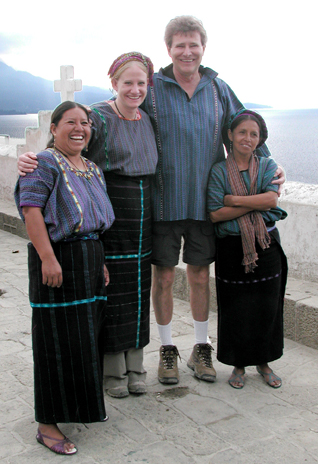 For short timers one of the best ways to get at least a feel for some of the villages around the lake is a boat tour that visits three Mayan towns, with a little time to look around in each of them. The last stop on the tour is San Antonio (where Faye and I met almost 11 years ago, and where we spent a little too long trying to live like the locals on return visits.) I still have friends there, and I met Clark and Anna Colleen when the boat arrived and introduced them to some of the villagers I know. Petrona and Maria, aunts of my godchildren had a good time dressing the two of them up in semi-traditional San Antonio outfits. I'm not sure they enjoyed it as much as the aunts did.
The dynamic duo left at the crack of dawn the next day to hike a volcano one day and tour Antigua the next. Then they flew to the northern jungle to visit the Mayan ruins of Tikal and do some sort of jungle canopy tour. Clark will need another vacation when he gets back home tomorrow afternoon.
Anna Colleen and I are planning on meeting at a bus station in Guatemala City tomorrow morning. From there we will go to Coban and, if we get there early enough, on to Lanquin near the sublime travertine pools of Semuc Champey. I'm really looking forward to hanging out there for a day or two. Then on to the tropical area around Lake Izabel and Rio Dulce. I've wanted to spend some time there for several years. Someplace with a hammock would be nice.
That's the plan anyway. It is good to have a plan, but not get too attached to it.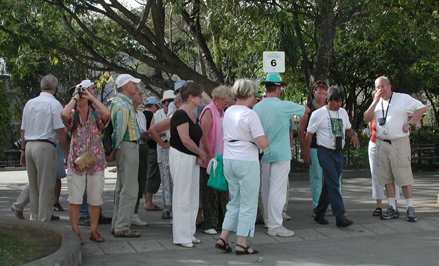 Yesterday morning I came down from Panajachel to Antigua. I felt more than ready to leave Pana, but I'm glad I'm not spending much time in Antigua. It is crawling with tourists and crowded with upscale shops and restaurants. That's fine, but it's not what I come to Guatemala for. I really have to wonder what a lot of these tourists come to Guatemala for. When they venture away from Antigua they travel around the country in shuttles, shoulder to shoulder with their fellow tourists, their Samsonite luggage stacked in the roof rack.
Of course, I shouldn't complain. I should just get on a chicken bus and head for the boonies. As long as there is a decent internet connection, I'll be happy.
Tuesday, January 16, 2007
The Existential Travel Agency
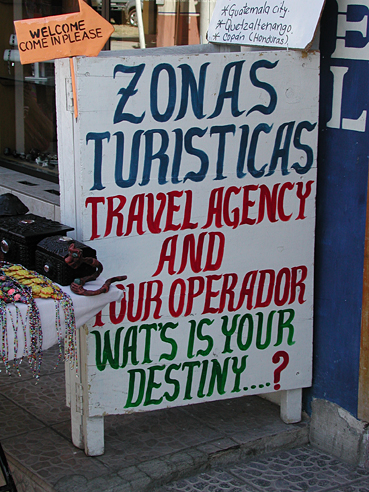
One of the benefits of travel is that one gets the opportunity to ponder life's big questions. Sometimes you are reminded of them in the oddest places. I wondered whether there might be a wall map inside this travel agency with an "X" on our location that said "Why are you here?"
Friday, January 12, 2007
Coffee and Cafes
I have pretty much recovered from our outing to the water park. It took a couple of days. Maybe I'm not getting in shape quite as fast as I thought. The streets of Xela have their ups and downs, and it seems like I spend quite a bit of time every day walking from one place to another, or sometimes just back and forth to the same places. Several of those places are cafes, so perhaps the effects of the exercise are diminished.
One of my favorite cafes just recently reopened after taking a break following the holidays. The menu is limited, but the specialty is chocolate. I've been there two days in a row with the kids--a cup of hot chocolate yesterday, and a moka float (chocolate ice cream) the day before. Chocolate milk for the kids. I'm thinking I'll have a chocolate sundae today.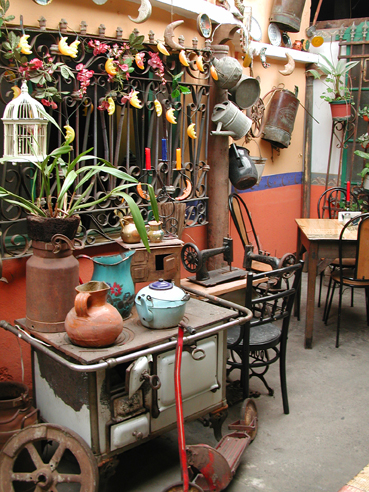
But there is more to the cafe than chocolate. It is as much museum as cafe. There is a small case with Mayan artifacts, but most of the displays are antiques from Xela's past. To look at them, if you didn't know better, you would have no idea that Xela was in the heart of a third-world country. Old typewriters fill a shelf that runs all the way along one wall just below a row of old leather suitcases. On the opposite wall there is a shelf filled with radios from the 30s and 40s. I'm sure most of the rest of the country didn't have electricity, but in Xela there were broadcasts, both radio and television.
There is a doctor's kit with what looks like instruments of torture, but what were probably state of the art at the time. There are printed schedules and a seat from a railway that used to run through here. Opera glasses share a case with a collection of pistols. On the walls hang everything from rifles and ceremonial swords to watering cans.
The antiques are not unlike those found in cultural museums of the era in other cities of the world. There is still more real culture in Xela than anywhere else in the country, unless you count the Colonial theme-park of Antigua. Guatemala gained independence from Spain in 1847. A century of progress and promise was followed by a half century of exploitation. That is an oversimplification, but when I look at these things I can't help but wonder what this city, and this country could have been had its history been different.
My other favorite cafe is also a museum of sorts. The walls are covered with photographs, newspaper clippings and documents going back decades. Large graduating classes pose in front of local monuments, and there are portraits of local poets, politicians and society matrons.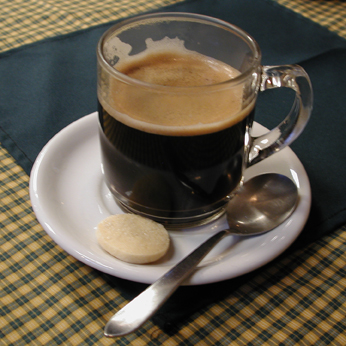
The coffee's not bad either, roasted on the premises. I usually order what they call the Americano which is strong and dark. But on the menu is something called the Atomic. I asked the waitress about it and she said it was three shots of espresso. I raised my eyebrows, she smiled just a little and said, "pure incense." It took me a few days to work up the courage to try it, but I did this morning. The waitress was right.
As much as I like coffee, I look forward to a hot cup in the morning even more here in Xela where the nights are chilly. There are two thick blankets on my bed, but sometimes that's not enough.
The place I am staying, where I always stay when I am in Xela, is cheap, with nearly 40 rooms that cost about $5, plus a dorm where a bed costs even less. The place is popular with budget travelers, mostly twenty-somethings. My room is in the geriatric wing, away from the patio where the kids sometimes hang out half the night. There are usually a handful of older travelers staying here, mostly Europeans, and the woman that runs the place puts us where it is quieter. Occasionally we exchange greetings in muddled Spanish or English, but little more.
Tomorrow or the next day I plan to head back to Lake Atitlan for a few days to warm up. On Friday I'm meeting my brother-in-law, Clark, and niece, Anna Colleen, back here in Xela. The two of them plan to cover a lot of ground in a week. Then Clark flies back, and Anna Colleen and I will go traveling for a couple more weeks. I better get rested up.
Monday, January 08, 2007
Wet and Wild
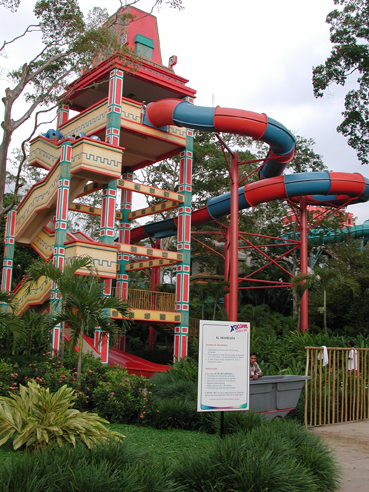
The water park, about an hour and a half down through the mountains towards the Pacific coast west of Xela, was great fun. With lush tropical landscaping and lots of good water slides, it very well done (a descriptor that is seldom applicable to things here). In fact, it was as good as any water park I've been to in the U.S., and maybe even more fun since safety seemed to be less of a concern. This is Guatemala, after all.
It ended up being an outing for quite a few of us--my godchildren and their parents, and a couple of aunts, one with her husband and two young children--a dozen of them in all, and me. I think everyone had a good time, but the adults didn't know how to swim and were afraid of the water slides. I stayed with the kids and they ran me ragged. The best rides were four stories high, and I don't know how many times we climbed the stairs to the top of those.
I spent a pretty big chunk of the kids' education fund on the trip. I'm not sure we learned anything, but it was a good time.
We went in the old Mitsubishi mini-van, about which I've written several times before. Though it has a new engine, I'm told, it is still a pile of junk. It struggles up every hill, backfires all the way down, and on the flats the engine dies every time the thing comes to a stop. But it got us there and back, so maybe I should let bygones be bygones.
Friday, January 05, 2007
City Life
Where tourism is the life blood of Panajachel, in Quetzaltenango foreign visitors are largely ignored. That is not to say that foreigners, whether upscale tourists or budget travelers, can't find places to stay and eat and plenty to do. It is just that Qutezaltenango is a city with other things to focus on.
Away from certain cafes, the cheap hostels which cater to budget travelers, and the language schools where travelers learn survival Spanish, it is not difficult to find yourself just about the only foreigner in sight. That is something you could never say in Pana.
Quetzaltenango, usually called Xela (pronounced SHAY-lah), from the much shorter old Mayan name for the site going back 500 years, is Guatemala's second largest city. The largest is the capitol, but Xela bears little resemblance to it. Guatemala City is chaotic, dirty, loud and, in spots, dangerous. Xela feels much calmer.
German immigrants came to the area in the 19th century to grow coffee. Their influence is still evident in the good bakeries, breweries and coffee shops. While more recently built parts of the city are the typically third-world uninspired concrete-block buildings, the older, central part of the city is dominated by large neo-classical stone architecture, and old, heavily plastered buildings, many of which are crumbling enough to show their adobe-block interior.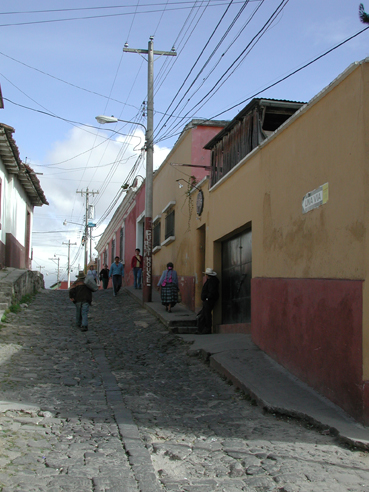 On Sundays, dignified old men wearing dark suits and fedoras promenade around the plaza and along cobbled streets, with their wives wearing patterned aprons over full skirts and heavy embroidered blouses (called huipiles,)and a strip of bright cloth woven into their long braids. It's the urban Maya look.
Years ago, when Faye and I were studying Spanish here, she tried to buy me one of those fedoras. Maybe she hoped that it would impart to me a dignity that I otherwise lacked. But alas, there were none big enough. I think if someone started making those things in larger sizes to fit fat-headed foreigners, they might do quite well.
Xela is known for its culture and educational institutions. There is a beautiful neo-classical theater with stone pillers, built around the turn of the century. It has been recently restored, but its first face lift came just a few years after it was built when a 1902 earthquake seriously damaged the theater and most other buildings in the city. (To add insult to injury, a nearby volcano erupted the same year, causing further damage.)
When the schools are in session (they start the new school year next week) sidewalks are often crowded with uniformed students-plaid skirts and white blouses for the girls and shirts and ties for the boys. There is also a large professional class, and between them and the well-dressed students it's enough to make a road-worn traveler feel rather shabby.
The main reason I come to Xela, and to Guatemala for that matter, is to visit my godchildren and their family, who moved to the city from a village on Lake Atitlan. I met them there over ten years ago (and also met Faye in the same village about the same time). They have been here in Xela several years now, and though I had some fears for them at first, they clearly made the right decision. There are numerous educational options for the kids, and more business opportunities for their parents, who were weavers in the village.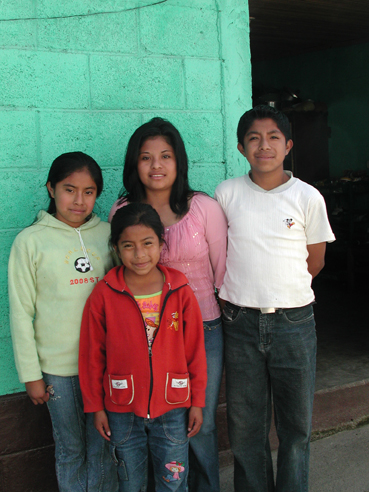 My four kids range in ages from eight to fifteen. Their older brother is 17, and starts university next week. Considering that their parents never got past second grade, that is quite a leap in a single generation, and one I am very happy to see. They all have come a long way, much further than I could have imagined when I first met them.
I'm not sure I am a very good example to the kids while I am here. I seem to spend a lot of time with the younger ones at the mega-mall window shopping, eating junk food in the food court, and playing games downstairs in the amusement area. (I have a headache from the bumper cars.) But it is what they want to do. I guess it won't do them any lasting damage, and I'll probably recover too. They are growing up fast, and soon they will outgrow such simple pleasures.
One of the more serious parts of my job as their godfather is to take them shopping for school supplies. The schools helpfully provide each student with a list. When the kids lived in the village, school shopping was quite an adventure in the nearby markets and small shops. Here in the city we went to a huge store much like a Fred Meyer in the States. Pretty boring.
In the few days we have left before school starts we are going to make the most of it. We are planning a trip to a water park I've wanted to go to for years. I think the kids are old enough now that they are not likely to drown. Of course, I am old enough that they may have to wade in and rescue me.
Monday, January 01, 2007
The Big Bang
Well, I guess it is safe to say, New Year's Eve was a blast. My ears are still ringing. Mike's extravaganza went off well before midnight, so I was back at my little hotel, up on the rooftop patio when all hell broke loose in town. I was in bed by ten past midnight, and fell asleep to the sounds of fireworks, and someone throwing up in the communal bathroom downstairs.
 Mike's coffee shop was closed, but I stopped by in the afternoon to check out the pile of pyrotechnics he had assembled for last night's show. In addition to several long (100 ft.) rolls of firecrackers, which are lit at one end and explode for several minutes, and bottle rockets that look like they could take down low-flying airplanes, there were some large creations with ominous names such as "Illegal as Hell" and "bin Ladens" (which are "firecrackers" the size of oatmeal cans. Osama only wishes he had that kind of firepower.)
 The show itself was like a cross between Dante's Inferno and a Fellini movie. A crazed cadre of helpers illuminated by showers of fire ran around the lawn of the hotel where the fireworks were planted lighting fuses. No one was injured (except for a few burns), but a nasty accident was averted when one helper unwittingly stepped in front of a bottle rocket just as it took off in the direction of the assembled guests.
We came back to town about 10:30 and I walked through the streets where mostly young revelers were throwing fireworks at cars and each other, and getting drunk in the most exuberant way they could think of. They made me feel old and overly serious (or at least overly sober.)
I retreated to the safety of my little hotel where the family that owns the place and some of the other guests had gathered on the patio above the second floor. A German family passed around sparklers and lit off strings of firecrackers, a couple of young American guys threw bombs onto the roofs below us (they meant for them to explode in the air, but were afraid to hold onto them until the fuse was short enough), and the hotel owner rang a bell during the five minutes leading up to midnight. Around the town hundreds, if not thousands, of dollars went up in smoke.
Then I went to bed.
I had planned on moving on to Quetzaltenango today, but the buses aren't running. So I'll hang out here today and go tomorrow. I'm tired of tourists, and it will be a good change of scenery. It has been two years since I've seen my godchildren in Quetzaltenango, so I'm looking forward to spending some time with them.

New Year's Day
Well, I guess it is safe to say, New Year's Eve was a blast. My ears are still ringing. Mike's extravaganza went off well before midnight, so I was back at my little hotel, up on the rooftop patio when all hell broke loose in town. I was in bed by ten past midnight, and fell asleep to the sounds of fireworks, and someone throwing up in the communal bathroom downstairs.
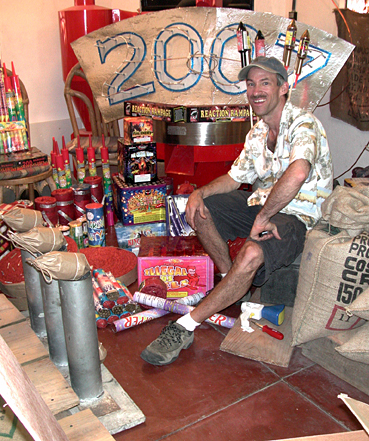 Mike's coffee shop was closed, but I stopped by in the afternoon to check out the pile of pyrotechnics he had assembled for last night's show. In addition to several long (100 ft.) rolls of firecrackers, which are lit at one end and explode for several minutes, and bottle rockets that look like they could take down low-flying airplanes, there were some large creations with ominous names such as "Illegal as Hell" and "bin Ladens" (which are "firecrackers" the size of oatmeal cans. Osama only wishes he had that kind of firepower.)
 The show itself was like a cross between Dante's Inferno and a Fellini movie. A crazed cadre of helpers illuminated by showers of fire ran around the lawn of the hotel where the fireworks were planted lighting fuses. No one was injured (except for a few burns), but a nasty accident was averted when one helper unwittingly stepped in front of a bottle rocket just as it took off in the direction of the assembled guests.
We came back to town about 10:30 and I walked through the streets where mostly young revelers were throwing fireworks at cars and each other, and getting drunk in the most exuberant way they could think of. They made me feel old and overly serious (or at least overly sober.)
I retreated to the safety of my little hotel where the family that owns the place and some of the other guests had gathered on the patio above the second floor. A German family passed around sparklers and lit off strings of firecrackers, a couple of young American guys threw bombs onto the roofs below us (they meant for them to explode in the air, but were afraid to hold onto them until the fuse was short enough), and the hotel owner rang a bell during the five minutes leading up to midnight. Around the town hundreds, if not thousands, of dollars went up in smoke.
Then I went to bed.
I had planned on moving on to Quetzaltenango today, but the buses aren't running. So I'll hang out here today and go tomorrow. I'm tired of tourists, and it will be a good change of scenery. It has been two years since I've seen my godchildren in Quetzaltenango, so I'm looking forward to spending some time with them.
contents copyright ©2005-2009 Jim McCluskey