




Saturday, December 30, 2006
That Ringing Sound
I don't like alarm clocks, never have. Whether early or late, I prefer waking up naturally. Less than a hundred yards from my room is the mother of all alarm clocks, dual church bells, tuned to a particularly annoying dissonant interval. At 6:30 every morning the bells are rung, at first slowly--one then the other--gradually picking up speed over the course of a few minutes to a frenzied finale. For good measure the ringing is repeated at 6:45 and 7:00. I usually go back to sleep, which just means I have to endure a rude awakening three times a morning, rather than just once.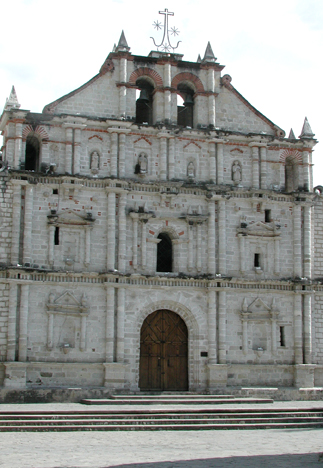 Guatemalans are early risers (I blame uncomfortable beds) and their day is well under way by 6:30. As far as I can tell, the bells serve no purpose. Maybe there is an early Mass--I've never gotten up at that hour to check.
Maybe the Church, as an institution, has the same attitude about sleeping during daylight hours my father did. Even as an adult I would get calls from him at ungodly hours of the morning for no particular reason. "Are you awake?" he'd ask without hint of apology.
Mike's coffee shop, the Crossroads Cafe, and their house, right above the shop, is even closer to the bells than my room is. But Mike and family have already been up and at it for a long time by the time the bells ring. The coffee shop doesn't open until 9 a.m., however, so if I get up much before that I have to start the day doing something besides nursing a cup of coffee. I'm pretty grumpy after being woke up three times in a row, so it is safest to start off with the coffee.
--------
The town is filling up with people here for the holiday weekend. Most of the action in Panajachel is on one main street, which runs directly down to the lakefront. It is lined with restaurants and stalls selling all kinds of Guatemalan tourist stuff. Some of it is authentic and quite good. But much of it is not. Most tourists can't tell the difference.
There is one particular tablecloth kind of thing which is colorful, but very badly made. Tourists buy a ton of them. A few years ago one Mayan vendor asked Faye and I what the name for them was in English. We said "Crapola," with as straight a face as possible. Unfortunately, it didn't seem to catch on.
Fireworks are a big seller right now. Lots of tables are piled high with explosive devices, from little poppers children throw on the ground in front of unwary pedestrians, to huge creations that can only be described as bombs. I used to buy the biggest ones I could find, but now they are so big that it feels dangerous even looking at them.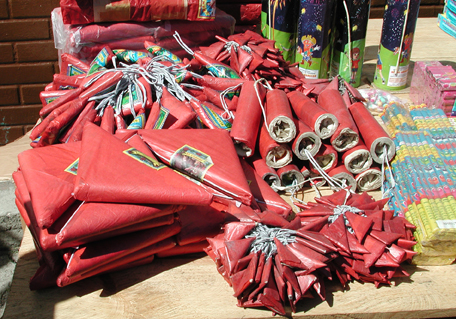
For my friend Mike, there is no such thing as too big. The more firepower the better. On Sunday night he will be in charge of the third annual fireworks extravaganza at a nearby resort hotel. I was there for the first one. This morning I saw some of his preparations for Sunday's show. I will try to take some pictures, but I may have to do it from a bunker.
---------
Just in case any readers are concerned about the money situation here (which is good practice for a cashless economy), I did manage to find one ATM in town with some money in it. I could identify the working ATM by the long line. I was afraid it would run out again before I got there, but it didn't.
The banks wouldn't even exchange Guatemalan currency for American dollars. A few days ago I got a small advance on a credit/debit card, but the banks were not doing that today either. It's crazy. I heard a couple more rumors as to the reason for the shortage of cash, but nobody can say for sure. You can get by here pretty cheap if you have to. It is amazing how many fresh, hand made tortillas you can get for a quarter.

Friday, December 29, 2006
Coffee Farm
When I am in Panajachel I usually start my mornings at the Crossroads Cafe, where my friend Mike Roberts offers up what may be the best coffee in Central America (not to mention excellent pastries made by his wife, Adele).
This morning I hadn't even gotten started on my first cup when Mike said, "Hey Jim, want to go to a coffee finca? We leave in twenty minutes." What few plans I have here are flexible, and a trip to a coffee farm sounded like fun. So I gulped my coffee and ran back to my room to get my camera. Mike left Adele in charge of the coffee shop and the two of us, along with one of Mike's daughters and a brother and his daughter visiting from New York, headed around to the other side of the lake, to the base of one of the volcanoes that dominate the horizon across from Panajachel.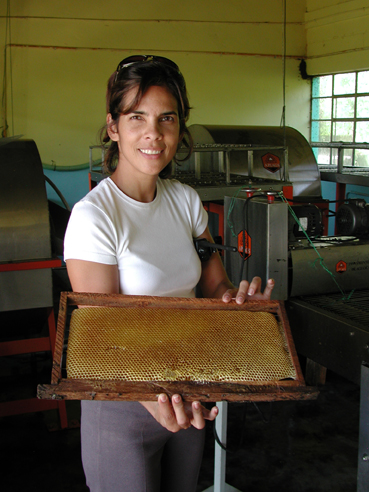
To call the place we visited a coffee farm is a serious understatement, because it is so much more than that. It is owned and operated by a couple, Sylvia and Carlos--she is originally from Ecuador and he is Guatemalan, with agriculture degrees from the University of Florida and Texas A&M. The finca is about 2500 acres, half of it a forest preserve and the rest comprised of not only a coffee plantation, but a large nursery with a million coffee seedlings and bamboo plants, a dairy, bee hives and a worm farm (and a small herd of goats who aren't earning their keep yet).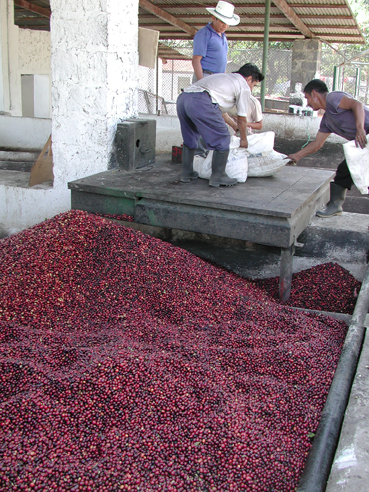
Each of the elements is interrelated: The bees not only make honey, but pollenate the coffee plants, which produce up to 40% more coffee than wind-pollenated plants. The cows produce milk, and manure which is used as fertilizer, and fed to the worms. The manure also produces methane, which will be used on the farm in place of propane. (There is also a hydroelectric plant that produces electricity.) The soft outer skin of the coffee bean, which is stripped off in processing, is used as a mulch and also used as worm food. The rich, organic soil produced by the worms is used for coffee seedlings.
The goal of the farm is to produce as little waste as possible during production of the various products. The idea seems to be working remarkably well, while at the same time producing excellent products. I sampled honey straight from the comb, some fresh cheese made from the cows milk, and a very tasty cup of coffee. (Mike is looking forward to getting a supply of coffee beans from the farm to roast and serve in his shop.)
The farm employs up to 800 local people around harvest times. Sylvia and Carlos are proud of the relationship they have with their workers, but stress that they don't give anything away for free, which fosters dependency. Instead, they offer jobs, fair wages, and training in marketable skills.
The farm is a model of production and innovation, but gaining acceptance for the ideas has proven difficult. Innovation is a hard sell in Guatemala, where sometimes it is difficult to tell the difference between tradition and inertia. Perhaps it is a sign of progress that Starbuck's has bought most of this year's crop. Of course, they will have to take what is left after Mike gets his.
Wednesday, December 27, 2006
Cash Crisis
It is always something here in Guatemala; there is always some problem with causes (and more importantly, solutions) unknown. At the moment there seems to be a shortage of cash in the country. ATMs are out of it, and banks are rationing the amount they will give out to people to Q500 (about $65) per day. On my budget that is little more than an inconvenience, but I imagine there are some tourists who are in a bit of a bind.
Some think tourists, and other ATM users, are to blame, that they have simply withdrawn too much, too fast. Others think it is a conspiracy to make the current administration look bad. Presidential elections are less than a year away, and already candidates are campaigning. Weird things happen in election years.
I asked the guy at the bank what the cause of the cash shortage was and he simply shrugged and said it was a national problem. He was confidant that the flow of money would resume after New Year's.
In the meantime, the newspaper suggests people use cash sparingly. Residents and upscale tourists can use their credit cards, but the places budget travelers frequent often do not take credit cards. It is almost like the old days when credit cards and ATMs weren't even available here. Two steps forward, one step back.
Tuesday, December 26, 2006
From Jet Planes to Chicken Buses
Today's trip to Guatemala started and ended in darkness. In between there were three takeoffs and landings, and a few hours of sitting around in airports. Everything went smoothly, and my luggage arrived on the same plane I did, so I can't ask for much more than that.
My flight into Guatemala City got in too late to get out of town, so I reserved a room in a little place near the airport (Hostel Hermano Pedro, if anyone wants to know). They met me outside the airport and brought me to the hotel, so that was easy.
Calling this place a hotel is not quite right. Probably the best description would be "guest house" which is quite a bit less formal than a hotel. It may have been a family residence at one time; in fact, I think the couple that owns the place lives in one part. There is sort of a living room area with family pictures on the wall.
It is costing me $22, which is three or four times what I usually spend on lodging, but it is fairly nice, and worth it under the circumstances. Not only do they furnish towels and toilet paper--which is a dead giveaway that it is a classier joint than I am used to--but they serve a Continental breakfast (scrambled eggs and refried beans, no doubt.)
There is cable TV, and at the moment I am watching Letterman. There are quite a few English language channels on cable here, including CNN and the major US networks. There are also a couple odd channels, out of Venezuela, I think. As bad as network television often is, these channels are worse. I'll describe some of the programs sometime.
Tomorrow I plan to catch a chicken bus up to Panajachel on Lake Atitlan. My plan is to spend the week there relaxing and catching up with friends, then go up to Xela, where my godchildren live, after New Years.
The weather is clear and a perfect 75 degrees. It is great to be back. Now I need to catch up on some sleep.
Yep, the breakfast was scrambled eggs and refried beans, along with white bread and instant coffee. On the plane someone asked me what Guatemalans typically eat. Tortillas are often eaten in place of bread, but that was pretty much a typical meal. The first time I came to Guatemala, twenty years ago now, I stayed with a family while I studied Spanish. I think we had some variation of that meal three times a day for the whole month I was there. I got sick and tired of it. Fortunately, this morning I was in the mood for it again.
The couple who ran the guest house took me to what is passing for a bus terminal these days in Guatemala City, and dropped me off right by the chicken bus I was looking for, which went directly to Panajachel.
Chicken bus drivers are well known for their attempts to pass anything that has even a slightly slower top speed than they do. It is a real contest, with the outcome often far from certain. I've seen a number of battered buses upside down in gullies. Until the first time I saw one of those I figured the bus drivers must be real pros who could fearlessly push the envelope without putting their passengers in any real danger. Now I know better. They are just crazy.
On the way to Pana I got to relive one of my favorite maneuvers. We came up behind a long semi-truck and trailer and the bus driver pulled out to pass as we were going uphill--on a blind corner. (That's why I don't like to sit up front. I'd rather not watch.)
Chicken buses pick up and let out passengers just about anywhere along their route. As the driver valiantly tried to pass the semi, a passenger slowly made his way through the crowded bus towards the front door. We managed to pull in front of the semi just as the passenger indicated that he wanted to get out.
To his credit the bus driver tried to eject the passenger without losing much momentum, but even that hesitation allowed the semi to pass us. By the time the dozen or so cars stuck behind the semi also passed us we had nearly come to a full stop and had to chug up the hill in low gear. What a humiliation!
That was the excitement for the trip. We made it to Pana in about three hours and I checked into the place I usually stay here (Villa Lupita's-- $5 a night). I took a stroll through town and almost immediately ran into a few ex-pats I know who live here.
I also ran into a traveler, named Eddie, who I know from when I was here two years ago. He stayed in the room next to mine. The main thing I remember him for was his screaming nightmares. It was pretty scary the first night, and thoroughly annoying thereafter. He is about my age and I thought maybe he had suffered some psychological damage in Viet Nam. But I don't think that was it. He always apologized for the screaming, but never offered an explanation as to why it was happening.
The other thing I remember about him was the impassioned eulogy he delivered when Hunter Thompson died. I know it was a dark day for all of us, but Eddie seemed to take it particularly hard. The eulogy drifted into a vivid description of the effects of abusing ether, which I think was something he and Hunter had in common (come to think of it, may that had something to do with the nightmares.)
When I ran into him today I learned we are both at the same hotel again, but I don't think we are next to each other. If he keeps me awake again I may actually carry out some of the nefarious ideas I came up with the last times he kept me awake. Maybe he needs some fresh reasons for nightmares.
December 25, Guatemala City
Today's trip to Guatemala started and ended in darkness. In between there were three takeoffs and landings, and a few hours of sitting around in airports. Everything went smoothly, and my luggage arrived on the same plane I did, so I can't ask for much more than that.
My flight into Guatemala City got in too late to get out of town, so I reserved a room in a little place near the airport (Hostel Hermano Pedro, if anyone wants to know). They met me outside the airport and brought me to the hotel, so that was easy.
Calling this place a hotel is not quite right. Probably the best description would be "guest house" which is quite a bit less formal than a hotel. It may have been a family residence at one time; in fact, I think the couple that owns the place lives in one part. There is sort of a living room area with family pictures on the wall.
It is costing me $22, which is three or four times what I usually spend on lodging, but it is fairly nice, and worth it under the circumstances. Not only do they furnish towels and toilet paper--which is a dead giveaway that it is a classier joint than I am used to--but they serve a Continental breakfast (scrambled eggs and refried beans, no doubt.)
There is cable TV, and at the moment I am watching Letterman. There are quite a few English language channels on cable here, including CNN and the major US networks. There are also a couple odd channels, out of Venezuela, I think. As bad as network television often is, these channels are worse. I'll describe some of the programs sometime.
Tomorrow I plan to catch a chicken bus up to Panajachel on Lake Atitlan. My plan is to spend the week there relaxing and catching up with friends, then go up to Xela, where my godchildren live, after New Years.
The weather is clear and a perfect 75 degrees. It is great to be back. Now I need to catch up on some sleep.
December 26, Panajachel
Yep, the breakfast was scrambled eggs and refried beans, along with white bread and instant coffee. On the plane someone asked me what Guatemalans typically eat. Tortillas are often eaten in place of bread, but that was pretty much a typical meal. The first time I came to Guatemala, twenty years ago now, I stayed with a family while I studied Spanish. I think we had some variation of that meal three times a day for the whole month I was there. I got sick and tired of it. Fortunately, this morning I was in the mood for it again.
The couple who ran the guest house took me to what is passing for a bus terminal these days in Guatemala City, and dropped me off right by the chicken bus I was looking for, which went directly to Panajachel.
Chicken bus drivers are well known for their attempts to pass anything that has even a slightly slower top speed than they do. It is a real contest, with the outcome often far from certain. I've seen a number of battered buses upside down in gullies. Until the first time I saw one of those I figured the bus drivers must be real pros who could fearlessly push the envelope without putting their passengers in any real danger. Now I know better. They are just crazy.
On the way to Pana I got to relive one of my favorite maneuvers. We came up behind a long semi-truck and trailer and the bus driver pulled out to pass as we were going uphill--on a blind corner. (That's why I don't like to sit up front. I'd rather not watch.)
Chicken buses pick up and let out passengers just about anywhere along their route. As the driver valiantly tried to pass the semi, a passenger slowly made his way through the crowded bus towards the front door. We managed to pull in front of the semi just as the passenger indicated that he wanted to get out.
To his credit the bus driver tried to eject the passenger without losing much momentum, but even that hesitation allowed the semi to pass us. By the time the dozen or so cars stuck behind the semi also passed us we had nearly come to a full stop and had to chug up the hill in low gear. What a humiliation!
That was the excitement for the trip. We made it to Pana in about three hours and I checked into the place I usually stay here (Villa Lupita's-- $5 a night). I took a stroll through town and almost immediately ran into a few ex-pats I know who live here.
I also ran into a traveler, named Eddie, who I know from when I was here two years ago. He stayed in the room next to mine. The main thing I remember him for was his screaming nightmares. It was pretty scary the first night, and thoroughly annoying thereafter. He is about my age and I thought maybe he had suffered some psychological damage in Viet Nam. But I don't think that was it. He always apologized for the screaming, but never offered an explanation as to why it was happening.
The other thing I remember about him was the impassioned eulogy he delivered when Hunter Thompson died. I know it was a dark day for all of us, but Eddie seemed to take it particularly hard. The eulogy drifted into a vivid description of the effects of abusing ether, which I think was something he and Hunter had in common (come to think of it, may that had something to do with the nightmares.)
When I ran into him today I learned we are both at the same hotel again, but I don't think we are next to each other. If he keeps me awake again I may actually carry out some of the nefarious ideas I came up with the last times he kept me awake. Maybe he needs some fresh reasons for nightmares.
Wednesday, December 13, 2006
Poker Politics
I've been playing a little poker lately. The more I play, the more I am seeing other things in terms of poker, or at least in terms of winning strategies. Poker is not a perfect analogy for the "war we now find ourselves in", as President Bush recently put it, but I think there are some parallels.
The most fundamental poker strategy is "know when to hold 'em, know when to fold 'em." Sometimes the right thing to do is to fold, cut your losses and wait until you have a stronger hand. Bad poker players hang on to bad hands, sometimes out of ignorance, but often for emotional reasons that don't have much to do with their cards. There is a name for players who do that: loser.
In poker parlance, George Bush has suffered a series of bad beats and is on tilt. Things haven't been going as well as he planned, and the decisions he is making have a lot less to do with the "facts on the ground" he keeps talking about, and more to do with the fear and anger he is no doubt feeling. A player on tilt makes bad decisions, letting his emotional state affect his judgement. There is plenty of evidence that George Bush's judgement has never been very good, but now it is worse.
Numerous times lately I've heard President Bush, and his proxies, say something like "We must succeed in Iraq, because the alternative would be disastrous." That bit of false logic sounds a lot like what I've said to myself as I contemplated a dwindling chip stack and a bad hand, then threw good money after bad and hoped for the best.
Hoping for the best is a bad strategy. It is a good way to go broke. In the small stakes games I play that doesn't amount to much. But in Iraq the stakes are so high that the consequences of losing are, to many, unthinkable.
So what do we do when the unthinkable becomes inevitable? (And when when did that happen? I'm guessing it was probably sometime between the toppling of the statue of Saddam and the day George Bush landed on the aircraft carrier and pranced about in a flight suit in front of the big "Mission Accomplished" sign. Only a moron would not be embarrassed by that misunderestimation of the situation.) Hoping for the best is not a good strategy, but that is about all we are left with. The only question is whether we pull out now and hope for the best, or throw more money and lives into the pot and hope for the best.
The family or backers of a gambler who found himself in the situation George Bush is in would be well advised to cut him off, especially if he was gambling with their money, as Bush is. Short of invoking the political equivalent of calling the security guards to throw him out of the game, I think the only option for the new Democratic Congress is to cut off his funding. Nothing good will come from staying in Iraq any longer.
The prayer of the desperate poker player is, "Lord, let me break even. I need the money." I don't know what George Bush prays for, but if he was smart, it would be something like that.
------------------
On a completely different subject, this blog is going to be shifting gears in a couple of weeks. (Out of neutral for one thing!) On Christmas Day I'll be flying to Guatemala and will spend the next three months there and Nicaragua. My intention is to post more regularly (and about something besides politics.) I'm looking forward to seeing friends, and getting to where it is warm and sunny.
contents copyright ©2005-2009 Jim McCluskey