



Monday, February 18, 2008
Room with a View
Our two weeks in Costa Rica, after we got out of San Jose and up into the mountains of Monteverde, were idyllic, about as good as it gets. Our friends Michael and Janet lent us their comfortable guest house with gloriously hot water in the shower, a full kitchen, king sized bed and a million-dollar view out over the Pacific lowlands, the gulf of Nicoya, and beyond to the Nicoya Penninsula. (The picture does not do it justice.)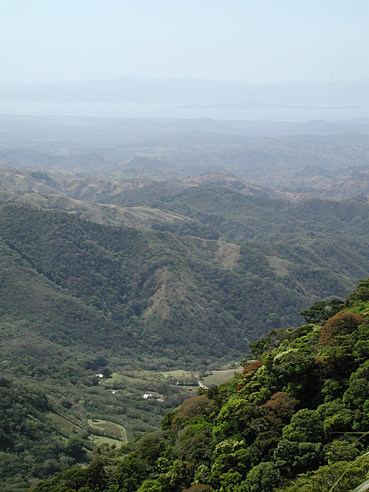
As I mentioned before, the three of us went to journalism school together. We all worked at it for a few years, but then moved on to other things. Now, the two of them are about as far away from journalism as you can get—they recently opened a boutique gift shop in Monteverde, and offer yoga classes and massage. Some years ago they also operated a restaurant in Monteverde. They are both excellent cooks and during our visit we were grateful beneficiaries of nearly nightly feasts.
Monteverde is more of an area than a town. In the early 50s several Quaker families from Alabama moved there after four Quaker men had spent a few months in jail for refusing to register for the draft. There was barely a road into the mountains where they settled. I saw some pictures of their vehicles being pulled through a quagmire by a team of oxen. I don’t know what the roads are like now during the rainy season, but aside from some recently installed pavement around Santa Elena, a small town just a few miles down the mountain, Monteverde is still more than two hours from paved road.
The Quakers bought farmland and cows and started making gouda cheese, which was a product that would survive the rugged trip to market. The cheese factory is still there, and is now a modern facility making 14 kinds of cheese and various flavors of ice cream.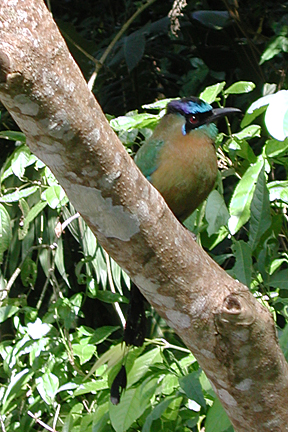 But the Quakers’ biggest contribution, and one that has shaped the area, was their purchase of a large parcel of cloud forest, which they set aside as a reserve. In spite of the road thousands of tourists come to the reserve to see the flora and fauna, including the Quetzal, a magnificent but elusive bird. Though it is the national symbol of Guatemala I’ve never met anyone in Guatemala who has seen one. (By the way, the bird in the picture is not a Quetzal, it is a Mot-Mot, which is very common, though beautiful, and sometimes called the poor man’s Quetzal.)
Some of the original Quaker settlers still live there, as well as second and third-generation descendents. There are also quite a few expats who have settled there in recent years, the kind of people who enjoy natural beauty, and a quiet lifestyle (as well as yoga and massage). Faye and I spent quite a bit of time walking the dirt roads through woods and past pastures, admiring spectacular views, and wondering whether Monteverde might be a good place to set up a base for our winter getaways.
We didn't go anyplace else in Costa Rica (and we didn't see most of the things tourists come to Monteverde for either!) But we'll be back. Costa Rica is better than we expected.
Faye is on a plane back home, as I write. Tomorrow morning I take the 3 a.m. bus back to Guatemala (with an overnight in San Salvador). Tonight I am back in San Jose. The crack heads on the street between my hotel and the bus station are getting rained on. (More weird weather!!) That might be a good thing though—there may be fewer of them to deal with when I make a run for the bus station in the morning.

Monday, February 04, 2008
Too Much of a Good Thing
Our departure from Nebáj was dry and dusty; there was mile after mile of road construction, and in spots it seemed like the heavy equipment was carving new road out of the mountainside in front of us as we bumped along. We were ready to find someplace quiet and refreshing.
After a one-night stopover in Coban, long enough to get some rest and make a quick visit to an interesting restaurant that serves cardamom-flavored coffee, we caught a mini-van up to Semuc Champey.
Semuc Champey is one of Guatemala’s natural wonders. The Cahabon River tumbles down through a narrow gorge and in a frothy maelstrom it disappears into the ground. Just below that vanishing act the water reemerges in a series of peaceful pools, shallow and sunwarmed. We spent a near perfect day swimming and admiring the beauty of the spot.
That night is started raining; at first it was nice, refreshing and rather novel. But rained and rained and rarely let up for most of the next week and a half. This is supposed to be Guatemala’s dry season. I don’t know what is going on.
We spent most of the time on or around water—another river and two more of Guatemala’s three great lakes. Lake Atitlán, where we’ve spent a lot of time, gets the most press and is, indeed, beautiful. But the other two lakes, Petén Itzá in the northern jungle and Izabal, which 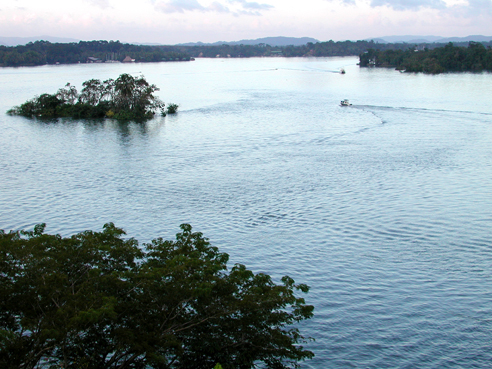 flows into the Carribbean via the Rio Dulce (Sweet River), are interesting and beautiful as well. They are warm and tropical, surrounded mostly by forest and jungle in contrast to Attilán in the western highlands, which is surrounded by steep mountains and volcanoes.
Rain on water is certainly better than rain on dirt and dust, and at least it was warm. But between the rain and the normal humidity of the area we were constantly damp. Our luggage had gotten rained on at one point and most of our stuff was damp too, and not drying out at all. We finally decided it was time to start the next leg of our trip and head down to Costa Rica. After 30 hours of bus rides, that is where we are now.
We got into San Jose late, nearly midnight. We were going to walk a block or so up to a hotel I had found online, but the cluster of taxi drivers waiting for the bus passengers all seemed to agree that walking in that area at night was a bad idea, even a block. So we took a taxi to another nearby hotel, one recommended by our helpful driver. It was only a block away too, but he drove us around a little bit pointing out all the crack heads lounging on the sidewalks.
The taxi ride was $4 and the hotel was $35. It didn’t take us long to figure out we had been suckered. The hotel was a roach infested flop house (literally! When the proprietor was showing us our room Faye pointed out a cockroach as big as my thumb. The proprietor tried to step on it but it scurried under our luggage.
The room did have a private bath, which is an amenity we often don’t have, but it was stinky and the sink drained into the shower stall. Not too classy. But we were exhausted and it was late, so we were ready to settle for anyplace. As we lay in bed I began to think the crack heads were probably better off than we were. That was probably the most uncomfortable bed I have ever been in. (Well, there was that one on the beach in El Salvador with the broken springs that kept poking us in the back. It was a real challenge to avoid puncture wounds, but the wind had blown the roof off and being able to look up at the stars made the uncomfortable bed seem not so bad.)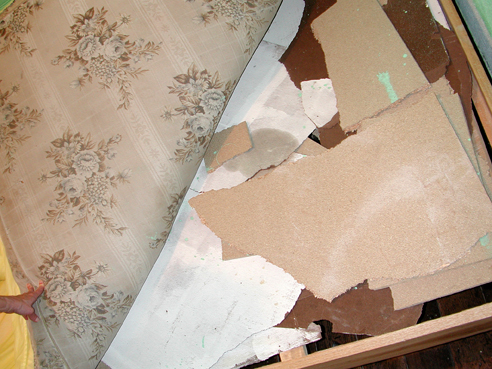 Anyway, the next morning Faye pulled back the thin foam mattress and we saw that it was supported by pieces of broken particle board and paneling laid across some widely spaced wood slats. Very creative. It didn’t take us long to check out of there and move to the place that I had originally selected, which turned out to be quite nice and $10 cheaper.
We spent one day walking around the center area of San Jose, trying to get a little feel for Costa Rica, which we’ve never been to before. Two things that impressed us was the number of lottery vendors and hair care salons and stores. It is hard to judge a people on such slim evidence, but from those two things I would say Ticos (as Costa Ricans call themselves) are optimistic and vain.
Unlike its Central American neighbors to the north Costa Rica has been stable and relatively prosperous for nearly all of its history. In spite of our first impressions, Costa Rica is significantly cleaner and greener than the countries to the north that we are more familiar with, and the general attitude seems more relaxed.
A phrase you hear over and over is Pura Vida which means something like “Life is good” (literally “Pure Life”) But it has so permeated the consciousness here that it is used to mean just about anything. For example, for some reason you can’t wear a hat in a bank. We entered a bank and a young guard asked me to take my hat off. When I did he smiled, gave me a thumbs up and said “Pura Vida.” I don’t know what it meant in that situation, but it made me feel good.
Our main reason for coming to Costa Rica was to visit some expat friends, a couple I’ve known since journalism school, more years ago than any of us want to admit. They live in Monteverde, an area known for its cloud forest reserve, which was originally settled by a group of American Quakers in the 50s. We’ve just been here a couple days and are looking forward to getting acquainted with the area, and the community of interesting people. We plan to be here a couple of weeks; already we’re wishing we had more time.
contents copyright ©2005-2009 Jim McCluskey