




Thursday, January 17, 2008
Beyond Statistics
Joseph Stalin said that a single death is a tragedy, a million is a statistic. When people talk about Guatemala’s “civil war” it is usually in statistics—30 years of fighting, some 200,000 killed or missing. (I put “civil war” in quotes because it is a misnomer; it implies two opposing sides more or less equally matched. The guerilla forces never numbered more than 5000 even at the height of the fighting in the early 80s, and that number was divided among four mostly unrelated groups. The government reaction was not so much a fight as genocide.)
One of the areas of the most activity was in the remote area known as the Ixil triangle, called that because the Mayas of that small and remote area speak a language by that name. During our stopover in Nebaj, the largest of three small towns that make the points of the triangle, we spent part of a day with a young man, Gaspar, who told us a lot more than mere statistics could.
For a period of about 15 years during the 70s and 80s the Ixil triangle was off limits to foreign travelers. The guerrillas hid in the rugged mountains and came into the village to get food and 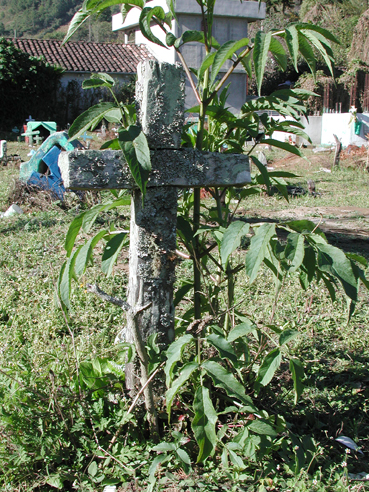 seek support. Government forces were not popular and villagers were to some degree sympathetic to the guerrillas. But any show of support was to invite retribution by government forces. The villagers were caught in the middle.
In the 1984 Gaspar was a boy of 11, living in Nebaj with his parents, three brothers and two sister. The Guatemalan Army killed everyone in his family except him. He, along with more than a dozen other children who escaped the slaughter, along with a handful of adults fled the village and the violence, and for the next six months made their way through the mountains into Mexico. He lived there until the peace accord was signed in the mid-90s, which brought an end to the fighting. Along with many other refugees he returned to Nebaj to start over with little or nothing.
Gaspar showed us a cemetery where 1200 victims of the fighting are buried, mostly nameless. He said he doesn’t know whether his family is in any of the graves or not. The remains of bodies are still being found, sometimes in mass graves. He took us to a memorial to some 250 children who were killed, where crosses are piled up before flickering candles.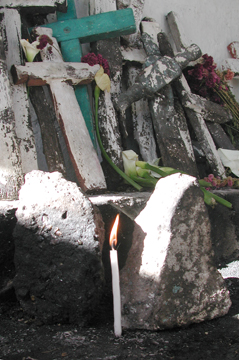
In a recent irony General Otto Molina campaigned for president of Guatemala in Nebaj last year. He talked about his role in the fighting, saying that he had come to the area to teach the residents how to defend themselves. We ran into an old gringo who has been in Nebaj for 30 years. He shook his head and laughed when he told us about General Molina. The last time he saw the General in Nebaj, in the 80s, Molina was shooting the Mayas. Maybe that is what Molina meant about teaching them self-defense.
Molina was the candidate of the “Patriotic Party.” The symbol of the party was a clenched fist, and the slogan was “A Strong Hand.” In the election run-off he was favored to win, but a larger than usual turnout of Mayas in villages such as Nebaj defeated him. Maybe they learned self-defense after all.

Sunday, January 13, 2008
City Life
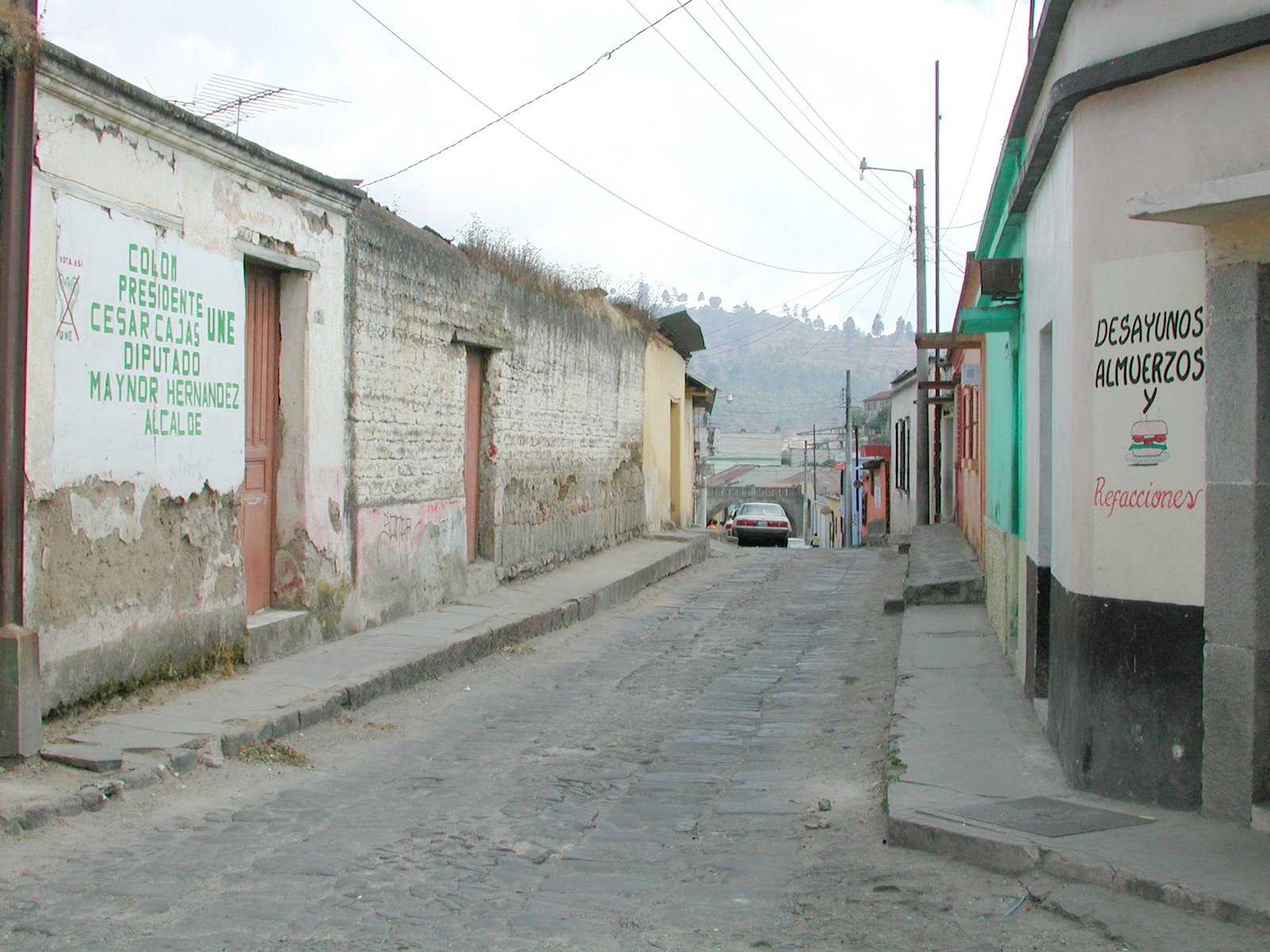 We’ve spent the last twelve days in the highland city of Quetzaltenango, a name that is a mouthful to say and even harder to spell. It is known more by its original Mayan name, Xelajú, shortened to Xela (SHAY-la). At over 7000 feet, the air is cool at night, and our cardiovascular systems get an extra workout as we walk up and down the hilly cobblestone streets. It is a pretty decent city by Central American standards, but we probably wouldn’t stay long except that my four godchildren live here with their older brother and parents.
The kids are all in their teens now except for the youngest, Sarita, who is nine. Yessica is 13, Winston is 15 and Angelina is 18. The oldest boy, Rolando, is now 20 and studying computer science in university. Angelina wants to be a doctor and will start taking some pre-med classes when school starts on Monday. Winston is interested in architecture. I don’t know what Yessica and Sarita will want to do, but their older siblings are setting good examples for them.
They’ve come a long way since I met them in the village of San Antonio Palopó on Lake Atitlan 12 years ago; they were living in a one-room house with dirt floors, mud walls and one bed for the whole family. But the place was tidy, and it was clear they were making the best of it. They are in a much better situation these days, with a decent little house of their own here in the city, with several rooms and beds for all.
The one bad thing about the kids growing up is that it is getting harder to entertain them when we come to visit. Or maybe it is getting harder for them to entertain us. Xela isn’t exactly Disneyland; there is a rather sad zoo with a handful of bored monkeys, a pair of equally bored but magnificent jaguars (native to Guatemala), assorted ducks and geese, and a crowded pen of rabbits, doing what they do best. There was a mangy lion, but it died. We went there first thing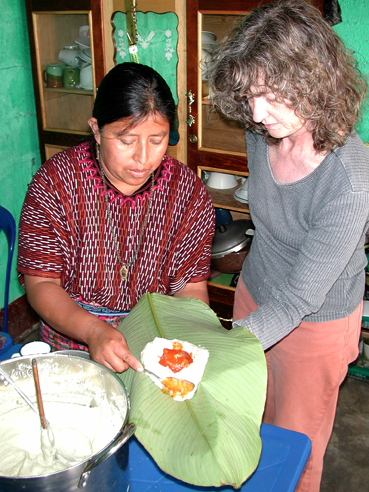 when we got here; after that it has been a challenge to know what to do.
A few days ago Faye expressed some interest in learning to make tamales, so Carmen, the kids’ mother, invited us over to their house for a couple of hands-on lessons. Faye did pretty good; I’m hoping that she’ll remember what she learned after we get back home.
One of the best things around here, in our opinion, is the hot baths in Almolonga, a village a few miles out of the city. The kids are not accustomed to hot water, or at least what we consider a decent temperature for a bath, so Faye and I went to the baths without them. The baths are rather basic—concrete and tile rooms. But there is plenty of space for two (or more) people to submerge in the gloriously hot mineral water. Whenever we are there soaking we say we should come more often, like once a day, but we usually only make it once a trip.
The place we are staying is a bit of a dive, but cheap ($8 a night for two). We stay here every time we come to town, but keep vowing we’ll find someplace better. The sheets don’t quite fit the bed, the electricity is off and on, and the showers are heated with electrical devices I call “widowmakers,” which are part of the showerhead. Imagine water running through a toaster. It has been a while since I actually got shocked during a shower, but it has happened.
So far on this trip we’ve been in very familiar territory. The next couple of weeks we’re going in search of places we’ve never been. Our first stop will be an area known as the Ixil Triangle, a mountainous area known not only for its beauty, but for its violent past, both during the Spanish conquest and more recently during Guatemala’s civil war.
Speaking of politics, the new president, Alvaro Colom, gets inaugurated tomorrow. We’ll see if he can live up to his promises.
Tuesday, January 01, 2008
New Year’s Day, 2008
For Faye and I, still in Panajachel, the old year ended with a bang, and the new one is beginning with a whimper. We were going to go on to Quetzaltenango this morning, but Faye woke up with an upset stomach, so we decided to stay put for another day. Nothing serious, just the usual minor intestinal distress that often happens about a week into a trip. It allows us to economize on the food budget for a day or so.
Panajachel is a destination for partiers over the holidays, particularly around Christmas and New Year’s. There are plenty of good restaurants and bars, as well as little grocery stores selling booze. The streets fill up with revelers, mostly youthful Guatemalans, clutching quart-sized bottles of beer.
The only thing that could make public intoxication more fun is large quantities of fireworks, some of them massive, bomb-like creations. There don’t seem to be any restrictions on firepower here. No one bothers with the stubby little firecrackers we are familiar with back home, unless it is a string of a thousand or so of them, all lit off at the same time. At the other end of the spectrum there are “firecrackers” as big as an oatmeal can that can pound your innards from a half-block away.
The firecrackers are made of gunpowder and newspaper. This morning the streets were covered with old news. By this afternoon the sweepers should have the streets clean, providing a symbolic beginning to the new year.
During the past week we’ve taken a few excursions. There are a dozen or so Mayan towns and villages around Lake Atitlan, all but Panajachel named after one of the twelve apostles. One day we took a ride across the lake to San Juan (Saint John). Weaving is prevalent among the Mayas throughout Guatemala’s highlands, but for many years the vibrant colors associated with Mayan textiles have come from modern aniline dyes. In San Juan weavers are preserving the knowledge of old, natural dyes, mostly plant-based. The hues are more muted, almost pastel, and are a relief from the brilliant aniline colors.
Near the dock there was an interesting demonstration project using trash as filler in walls,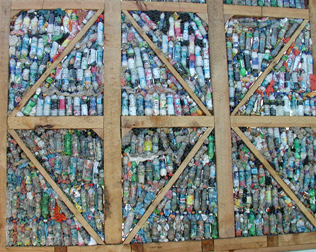 sponsored by outsiders, I suspect. Guatemalans seem to think nothing of littering, and plastic bottles, bags and other garbage seem to be everywhere. Someone got the bright idea of stuffing plastic bags into plastic bottles and filling in walls made of a wood framework covered in chicken wire. The wire is then covered with stucco or adobe to complete the wall. It is an interesting idea. I’m not sure anyone here needs the insulation, but if it gets rid of some of the trash I guess it is a good thing. Recycling hasn’t caught on here yet.
Yesterday we took a quick trip out to San Antonio, also on the lake, (where Faye and I met twelve years ago) to visit some old friends, mostly aunts of my godchildren. We were there just long enough to catch up on some of the gossip; one of the aunts is pregnant with her eighth child, against the advice of everyone else in the family. No one (but her, presumably) knows who the father is. Her other seven children have been fathered by three different men.
Another friend we visited, Paulina, I’ve known for probably 15 years, since she was a young girl selling stuff to tourists in Antigua. She is grown now, with two or three kids of her own.
Paulina and her husband, Juan, opened a shop selling weavings and other Guatemalan handicrafts several years ago. A couple years ago they opened a restaurant above the shop. Things seemed to be going OK, but Paulina said Juan was worried about having enough money to send the kids to school, so he left for the US to find work (illegally). She hasn’t heard much from him, but I guess he isn’t making the money he thought he would. She is struggling with the shop and restaurant.
Juan and others used to ask me about jobs and wages in the US. Here the minimum wage is about $6.25 a day, so when they learn one can make that much in a hour in the US it sounds pretty good. But I always tell them that while wages are higher, so are expenses; it is pretty difficult to live on minimum wages much less have anything to send back home. So Juan is learning the hard way. I don’t know how Juan got to the US, or how much it cost him. A Mexican coyote, a smuggler who takes illegals across the border, charges about $6000. And for Guatemalans, getting through Mexico is as difficult as getting into the US. If Juan gets caught, at least the trip back home will be free; the US deported more than 23,000 Guatemalans last year.
Paulina asked me to look for a school sponsor for her oldest, 9-year-old Yessica; if anyone is interested, let me know. I can say from experience that it can be a rewarding relationship. And if Juan can come home both Paulina and the Department of Homeland Security will be grateful.
If all goes according to plan we will be in Quetzaltenango for the next couple of weeks, hanging out with my godchildren and their family.
contents copyright ©2005-2009 Jim McCluskey