




Saturday, January 16, 2010
Temporal Field Distortions
We left Luang Prabang feeling a little sick to our stomachs—which was an improvement over how we had felt the past two days.
A day or so after we got to town we discovered a street vendor selling a delicious all-you-can fit-on one-plate vegetarian buffet, for about $1. Such a deal. We ate there three nights in a row with no ill effect. We got done in by a restaurant. We decided to splurge and had some Indian food as a treat. You never know what’s going to get you.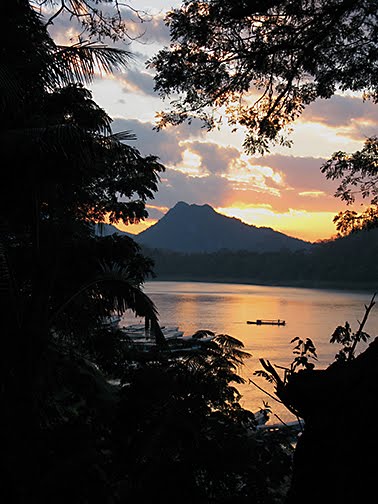 But Luang Prabang also left us feeling a bit nauseous less literally. We never did quite warm up to it. It has been designated a World Heritage City by UNESCO and it certainly has some Old World French Indochina charm, as well as it’s own Lao/Buddhist character. Sunsets on the Mekong are very nice, especially seen from one of the riverside bars. But Luang Prabang also has an international airport with flights from several neighboring countries. It is just a little too easy to get to.
My first impression was that it was a place being smothered by tourism, and I still felt that way when we left town. As our mini-van drove around collecting other travelers headed southward like ourselves, I saw a couple on the garden patio of their hotel, eating their continental breakfast, dressed in their hotel-issued plush robes. I’m sure their room cost as much per night as we spend in a week or two on accommodation. I think the future of Luang Prabang belongs to people like them.
Ironically perhaps, our next destination was another legendary tourist-swamped town, but filled with a completely different class of tourists—young international hedonists. Think Spring Break in Ft. Lauderdale.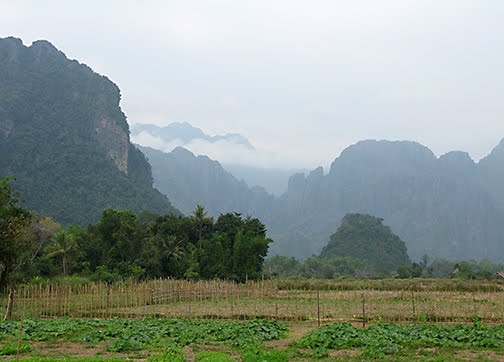 Vang Vieng is a very small town in a spectacular setting. A river flows along the edge of it. Nearby, beyond fields and rice paddies, clusters of tall limestone bluffs thrust up out of the river valley floor. Partially covered with trees and dense vines, the formations look like something from the prehistoric world. Energetic climbers scale the cliffs; the less energetic explore numerous caves and caverns in the limestone.
 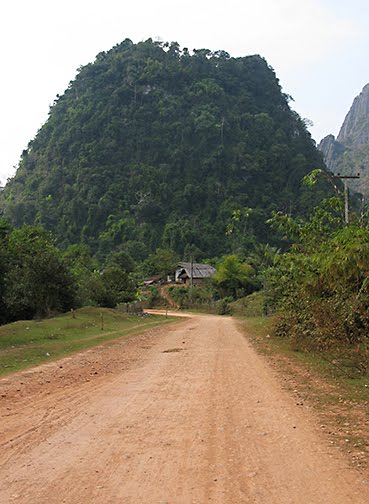 We rented a motorbike and drove past them, on miles of dirt roads, through creeks and several small villages of bamboo huts. People waved and children shouted out to us as we drove by. Several times we stopped to ask for directions. Between them not understanding our questions (or being able to read our map) and us not understanding their answers, we got fairly lost. We’re still not quite sure where we went.
In one village surrounded by stunning, jungle-covered limestone peaks, we stopped at a little shop that had been set up in the front yard of one of the small houses. We ordered a couple of sodas and chatted with the man and woman who evidently lived there. And by “chatted” I mean we talked, and they talked, and none of us had any idea what the other was saying.
Well, we did have a little breakthrough—Faye pointed to a satellite television antenna in the neighbor’s yard (villages aren’t what they used to be) and said, “TV”. The couple seemed to recognize that word, then told us the word for television in their language. It was probably Lao, but perhaps some other local language. It didn’t really matter because we would have had to spend the rest of the afternoon there repeating the word for it to stick in our heads. Didn’t seem worth it.
As beautiful and peaceful as the village and the countryside around it were, the town of Vang Vieng is something else entirely. The few streets it has, mostly dirt, are literally filled with bars, cheap guesthouses, restaurants, internet cafes, and travel agencies … and something else I don’t quite know what to call.
I have a theory that clumps of tourists cause temporal field distortions—odd little bubbles of alternate reality, areas of bizarreness that sometimes defy explanation. Viang Veng is famous for two things—and I’ll get to the second thing shortly. Around town, sometimes side-by-side, there are these open-air … I’ll just call them TV lounges. They are basically low tables with cushioned seating areas facing several synchronized televisions, all playing endless episodes of “Friends”. It is truly one of the strangest things I’ve ever encountered. Any time of day or night there will be people laying around watching these reruns—and sometimes the places are packed.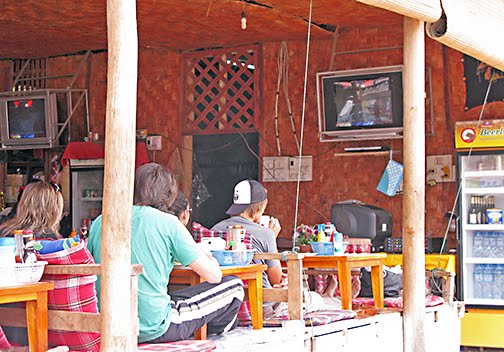
We may not go rock climbing, or mucking through caves, but we could not pass up participating in this bit of bizarreness. We sipped bad mixed drinks and lounged through several episodes one evening—Season 3 I think. It is amazing how short the episodes are without commercials, or maybe for some reason we just lost track of time. We finally stumbled out of the distortion field around 10:30 at night to make our way back to our room on the quiet side of the river, just as the rest of the town was getting warmed up for a night of partying.
Speaking of river, the other thing the town is known for is tubing. You can rent big inner tubes and a tuk-tuk will take you upstream a few kilometers and you float back to town. Or at least that is what the naive (us) think. I am a big fan of floating down rivers on inner tubes. It offers just the right combination of getting out in nature and relaxing. So we rented our tubes, climbed on a tuk-tuk crowded with mostly enthusiastic 20-somethings and got dropped off at the river upstream.
It was right about then that we got the feeling that “tubing” was some sort of euphemism. On the banks of the river were three or four wooden decks with bars, all with music amplifiers cranked up to 11, all completely packed with drunken kids (a lot of Australians—and nobody parties like Aussies!). Giant beams were tilted out over the river and cables with sort of zip line/trapeze contraptions ran between them. People would sail out over the river screaming and hooting and plummet into the river, sometimes gracefully, usually not.
The different decks competed for customers by throwing plastic bottles tied to ropes into the water towards people swimming or floating. People could grab the bottle and be towed (or rescued from drowning) to the deck of their choice.
Faye and I felt surprised and bewildered. We had come to go tubing and were mentally unprepared for the scene that met us. We seemed to be unable to shift gears, to adopt the new paradigm. Or maybe we were just too old for that kind of thing. I wasn’t quite ready to admit to that, but I really was looking forward to tubing.
I had spent every spare moment of my childhood summers floating down the river on truck tubes, and was completely comfortable now throwing my tube in the water and jumping off the rocks at the side of the deck, just like old times. But Faye got in a few yards upstream where she could wade in. By the time she got into the water I was already floating out in the middle of the maelstrom. It was surreal and crazy, and kinda fun.
The next time I saw Faye the current had pulled her into a calm area between two of the decks—well, calm water anyway, though otherwise anything but. She still hadn’t got the hang of navigating the inner tube and hadn’t really focused on what was going on with the bottles. I called to her to paddle out into the middle of the river where the current was. With a look of fear on her face she shouted “They’re throwing things at me!”
Maybe it was the shot of Lao whiskey someone had forced on me as I made my way across the crowded deck before I got in the water, but I thought that was hilarious. I wanted her to relax and enjoy it as much as I was, and I started to explain that the bottles were not projectiles aimed at her, but sort of like life preservers. Happy young people wanted her to come party with them.
But just as I started to say that somebody sailed out over the river on a trapeze and cannonballed right behind her. The look on her face told me that her fear had turned to terror. I heard her cry out—to me or to God, I don’t know—“Get me out of here!”
She managed to escape, and the rest of the trip down the river was pretty much what we expected tubing to be. We did pass a few more riverside bars. One tried to lure us in with signs promising “Psychedelic Mushrooms” and “Happy Brownies,” but we decided against those treats. Last time we checked it wasn’t the 60s anymore. Or maybe we were passing through another temporal distortion field.
We floated along the base of some fantastic limestone bluffs. Downstream a ways we passed a small herd of water buffalo nearly submerged in the river. At some point Faye said, “I’ll bet most of the people up there never float down the river at all. They’re all too drunk.” And it was true.
That evening, after the sun had set, a tuk-tuk packed with partiers, their inner tubes loaded on top, passed us in the street. Four Aussies rode on the rear bumper with their pants down around their knees, shouting and trying to hang onto the vehicle and a beer at the same time. I had finally learned the true meaning of “tubing.” If only I had known.
After a few strange but oddly enjoyable days, we moved on to Vientiane, the capitol of Laos, where we are now. We’ll be here for a few days, waiting for the Myanmar/Burma embassy to process our visas.

Friday, January 08, 2010
Slow Boat to Luang Prabang
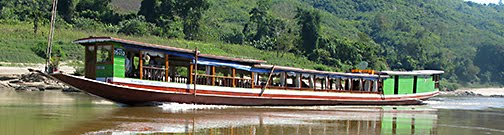 To me, that sounds like a good title for a novel—Slow Boat to Luang Prabang. The ideal length for such a book would be something one could read in two days, the amount of time it took us to get down the Mekong River to Luang Prabang from our departure point, Huay Xai (spelled a half dozen different ways, but pronounced “whey sigh”).
Huay Xai is just across the river from the Thai town of Chiang Khong, where we spent the previous night. I guess our river trip actually began with a short ride across to Huay Xai on the Laos side the next morning where we, and about a hundred other travelers jostled to get through the border formalities. Nearly all were about to make the same trip we were.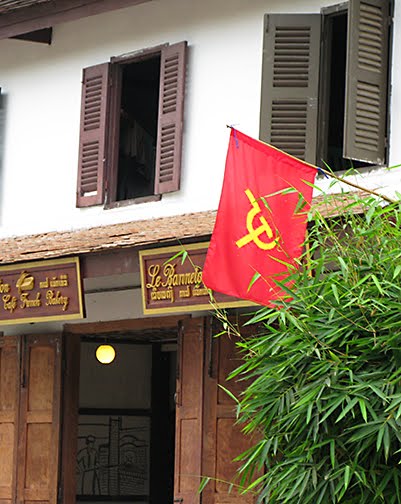 I hadn’t thought about Laos being a communist country, but several buildings near the boat landing were flying the hammer and sickle. Yet, as I bought a few provisions at inflated prices, and given a very poor rate of exchange for some Thai money, free enterprise seemed alive and well.
There were enough travelers to fill two of the long boats that carry passengers and cargo up and down the river. We got on board, settled in for the trip, and got as comfortable as possible considering we were sitting on wooden benches.
Most of the impressions I had of the Mekong River came from my memories of reports from Southeast Asia during the Viet Nam war. The Mekong took on a mysterious and mythic status. 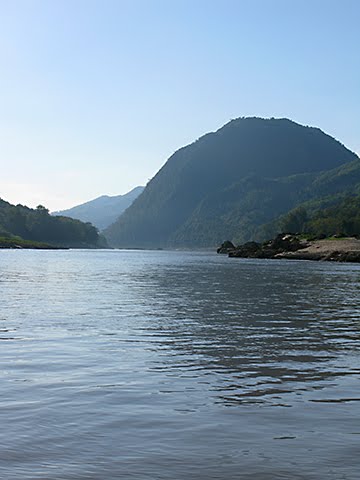 But as I thought about it, I realized those reports were from the southern end of the river, the Mekong River Delta. Whatever the realities of that end of the Mekong, then or now, where we were, much further north, was not what I expected.
The river flowed languidly past white sand beaches that would be the envy of any resort. Fantastic rock formations jutted out along the banks, or sometimes cropped right out of the water, all against a backdrop of dark green, mountainous jungle. Every so often we would pass a small village of bamboo huts. It is hard to tell much about a place just drifting past in a boat, but I was pretty sure I wanted to get off and live there.
The slow boats are called that not just because they are slow, though they are. The name distinguishes them from the “fast boats” that make the same two-day trip in six hours. The fast boats are basically small, river racing skiffs that hold a half dozen people. Every couple of hours or so one would rocket past us so fast I never did get a decent picture of one. The passengers, wearing life jackets and helmets, would glance over at us as they hunkered down in the speeding boat. I wondered whether they pitied or envied us. 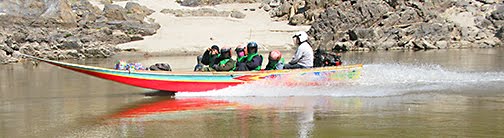
As night fell we pulled into Pak Beng,a town about halfway between Huay Xai and Luang Prabang that exists only to service the passengers traveling between the two places. It wasn’t nearly as seedy as we had been led to believe. Maybe the place has improved recently, or maybe our standards aren’t very high. For about $9 we got a pretty nice room, and for about the same price had an excellent meal at an Indian restaurant down the street.
The next morning we and all the passengers from the two boats that had come down the river the day before learned we would be crammed into one boat for the remaining trip. We were not happy. As the boat got fuller and fuller I began thinking about the ideal novel again, that maybe it would be subtitled Mutiny on the Mekong.
Faye and I got on two hours before the scheduled time of departure—experience has taught us it pays to be early. There were already a handful of other passengers on board, as well as an elderly local man, sitting in the front row. An hour and a half later, when nearly all the seats were full and there were more passengers waiting to get on, the wrangler told the old man to give up his seat. So he got up and trudged towards the back of the boat.
A young American woman, traveling with her husband and pre-pubescent daughter shouted “No, that’s not right! Let him sit there!” Somebody asked, “What’s going on?” and the woman said, “They just made that old man give up his seat so a tourist could sit there!” I thought, “Look around lady, this is a tourist boat.” But I kept my mouth shut, unlike the American woman who kept on about the injustice of it all.
As a few young Brits, who had been waiting on the bank got on the American woman said to them, “You have a seat because they kicked out an old man.” With admirable restraint, and a charming accent, one said, “We weren’t waiting for a seat, we were waiting for a different boat.” Then they all made their way to the back of the boat, leaving the front seat empty.
As the boat finally left, the American woman got up from beside her husband and moved to the old man’s empty seat to chat with some friends in the next row.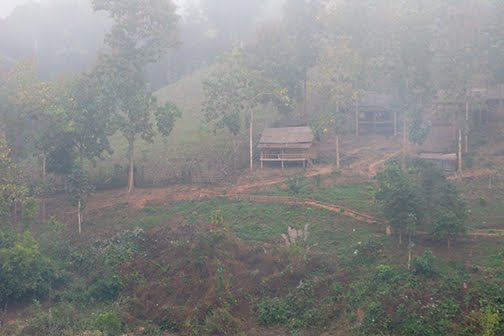 Aside from that excitement, and the crowding, the second day’s trip was much like the first. People passed the time taking pictures of the passing scenery, reading, and listening to iPods Some were drinking large quantities of beer and whiskey. You could buy beer on board, but it took more foresight than I had to think of bringing your own whiskey. (We had tried some Lao moonshine made from sweet rice in the restaurant the night before. It was really good, and costs just over $1 a bottle.)
The boat arrived in Luang Prabang on the evening of the second day. LP, as people on familiar terms with the town call it, has been a popular tourist destination since the early 90s since the communist government eased restrictions, and it is easy to see why. The town is in a beautiful location, bounded by two rivers, the Mekong and a tributary, the Nam Khan. From the late 1800s until WWII the French controlled the area and buildings from that era remain, giving the town a colonial feel. (Another legacy from the French era is good baguettes and decent, affordable wine.)
It is the kind of place one might think Hemingway would feel at home—if it weren’t for all the damn tourists. The town’s charm is being smothered by tourism. (Yes, I’m aware of the irony of us coming to town and complaining about the tourists. Pot, kettle, etc.)
All along the main street there are only restaurants, shops, hotels and tourism offices, all offering the same tourist activities as the office next to them—excursions to local waterfalls and caves, treks to tribal villages, and going to elephant camps with the chance to learn how to train your own elephant.
Not that those things aren’t fun and interesting and all that. If they weren’t they wouldn’t be so popular. We certainly enjoyed our experience with an elephant in Thailand. But it sometimes it feels like you are stuck in some sort of meta-reality with all your fellow tourists, unable to experience anything real, only what is packaged and presented to you.
At some point a destination can turn into a Disneyland. I expect someday there will be kiosks where you will just go buy a ticket for whatever attraction or activity you want to do (“You must be this tall to ride the elephants.”) I guess that is the fate of popular destinations all over the world.
One always hopes to find an unspoiled jewel of a place, with natural beauty, friendly people, and hopefully a few good restaurants and Wi-Fi. But I suppose that is unlikely. Short of that I still think I would like to go live in one of those riverside villages in a little bamboo hut.
We plan on staying in LP several days, maybe a week. We’re just in the getting acquainted phase, exploring the town on foot in ever widening circles, walking up streets and down alleys, poking our noses into anyplace that looks interesting. So far, even with the annoying tourists, it still seems like a very appealing place.
Friday, January 01, 2010
Chinese New Year
After an understandably quiet Christmas in this Buddhist country we started wondering where we should plan to be on New Year’s. We couldn’t justify dallying any longer in Chiang Mai, and we needed to be heading north in the general direction of where we would cross into Laos.
In Chiang Mai we had been talking with an interesting Thai shopkeeper, a young woman who came from a farming family in the eastern part of the country. In her business these days she traveled quite a bit, dealing with some of the hill tribes in the north. She suggested that we might find the town of Mae Salong interesting. It was Chinese, she said. Definitely odd, we thought, and maybe a special place to end the year and start the next. Except that to the Chinese, New Year isn’t until mid-April. But we had to find out what a Chinese town was doing in Thailand. 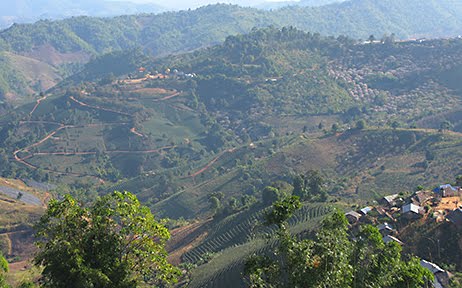
We took a bus north out of Chiang Mai to the end of the line, then got into one of the small pickups, with bench seats and canopy, that serve as public transportation in rural areas, as well as taxi’s in urban areas. Besides us and another traveling couple, the back of the pickup filled up with village people from local hill tribes dressed in bits and pieces of their traditional outfits. For the first time since we got to Thailand we were reminded of our travels in Guatemala.
Unlike the indigenous Mayan groups of the Guatemalan highlands who are the original inhabitants of the area, the dozen or so hill tribe groups of Thailand’s northern mountainous area are relative newcomers—migrants and refugees from Tibet, Mongolia, Southern China and other Southeast Asian countries.
As we learned, the most recent are the Chinese of Mae Salong, who are remnants and family of Nationalist Chinese soldiers who fought against Mao Zedong’s forces in 1949. While Chiang Kai-Chek’s faction fled to what is now Taiwan, a significant number of troops retreated into Burma, where they were attacked repeatedly by the Burmese. They were eventually expelled, some to Taiwan and others into northern Thailand. In the early 50s the king of Thailand, the same one who is on the throne now, granted the Chinese refugees in Mae Salong the right to remain and helped to foster aid projects for the area. The Chinese of Mae Salong maintain strong ties with Taiwan, sometimes sending their kids there to be educated.
By the time we got into town, the day before New Year’s Eve, Mae Salong was no longer the quiet little place it normally is. The handful of guesthouses were nearly full, taken by Thai vacationers who were pouring into town for New Year’s, and room prices had tripled. We didn’t have reservations, and the rather basic room we found had skyrocketed from $3 to $9 a night. In spite of things being not quite what we had expected, the town still seemed like it might be an interesting, off-the-beaten-path place.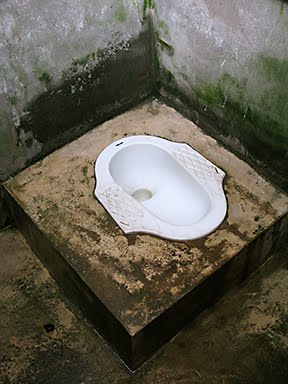 Turned out that it was off the beaten path enough that we could no longer avoid the dreaded squat toilet, which was out in back, down some shaky wooden stairs.
The squat toilet, common throughout Asia but often optional in areas frequented by Westerners, is little more than a glorified hole in the ground. I can only assume that its invention predates the invention of pants, which are a logistical nightmare.
Not only that, Asians must be a lot more flexible than I am. I am nearly as uncomfortable talking about squat toilets as I am using them, so I am not going to describe exactly how they are used. But I’ll just say this: Getting down with the people if fine, but what if you can’t get back up?
The last day of the year we rented another little motorbike and explored the picturesque hills around Mae Salong. There are a number of villages of different ethnicities in the area. Though the Chinese mostly live in concrete houses, thanks to the aid given them, the other hill tribe villagers still live in small houses on stilts made entirely of bamboo. They are pretty decent structures and, given a choice, I think I would prefer the bamboo houses.
In years past, and even today, the cash crop for the Chinese and others of the mountainous area where the three borders of Burma, Laos and Thailand meet, known as the Golden Triangle, was opium. Thailand has been quite successful in eradicating opium production by a combination of punishment and incentives, and in the area around Mae Salong the cash crop these days is tea. 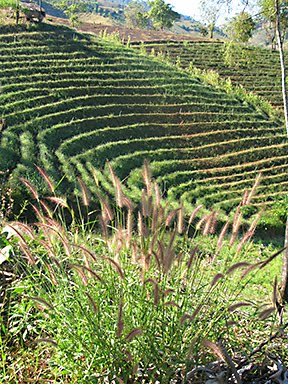 Terraced hillsides of tea bushes are scattered throughout the area, sometimes with rice paddies at the bottoms of the hills. In the town, tea flows freely. There are numerous shops selling tea and offering free tastings. At our humble guesthouse tea was not only complementary with every meal at the attached open-air restaurant, if we stood still for more than a few seconds in the lobby area a glass of tea would appear on the table nearest us. We drank a lot of tea.
For New Years, the Chinese of Mae Salong had geared up for the flood of Thai tourists with a tea festival. In an open area in the middle of town a couple dozen stalls of tea vendors vied for attention, urging tea tastings upon everyone passing by. And not tea bag tea, or kept-hot-on-a-burner tea—each cup was made fresh in a fascinating little process and served with some ceremony. We soon felt awash in tea, and guilty that we couldn’t buy a package of tea from every place that offered us a drink. (The tea was not cheap, probably about the same price as a similar quantity of opium. Perhaps they’ve taken the government’s “replace opium with tea” dictum a little too literally.)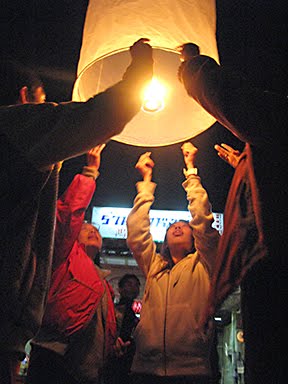 The tea stalls were along the sides of the field; in the center were examples of the bamboo houses from several of the local hill tribes. Inside one was a sample family, and we were invited in for—you guessed it—tea. We sat cross-legged around a little fire built in a clever earthen pad built right on the bamboo floor. Our guilt finally overcame us and we bought a package of ginseng oolong.
During New Year’s evening at the festival people were lighting lanterns that would inflate with the heat of the flame and drift up into the sky, carrying with them aspirations for the new year. We left the festival before midnight, returning to our guesthouse, not far from the festival, to celebrate a little more quietly with others there. At midnight the proprietor opened a bottle of Thai Scotch, poured us all a shot, and we watched as scores of the lanterns floated up into the sky past the full moon. The night was warm and beautiful. It was a memorable New Year’s after all.
We are now in Chiang Rai, a small city not far from the border. Our Thai visas expire in a few days, so we’ll be moving on to Laos shortly.
contents copyright ©2005-2009 Jim McCluskey